

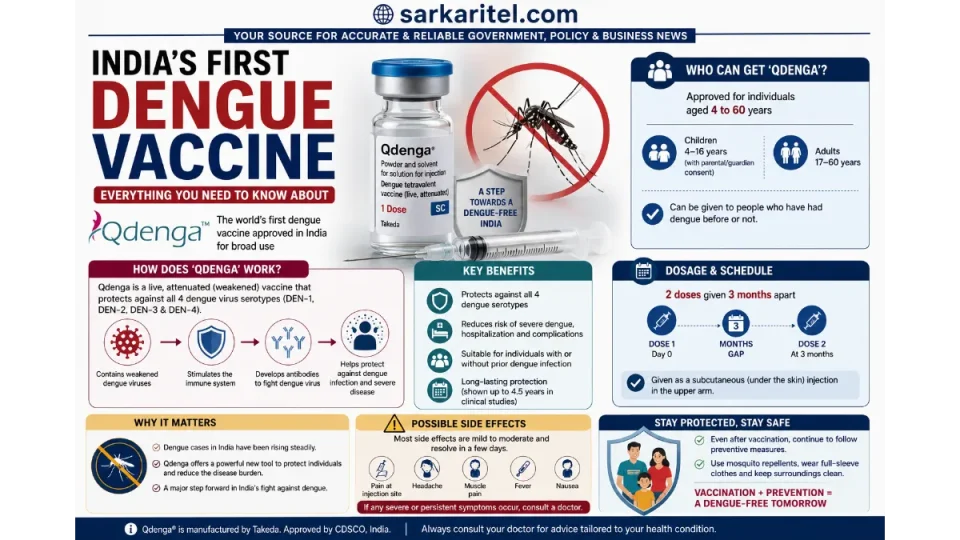
India has approved its first dengue vaccine, Qdenga, for people aged 4 to 60 years. Developed by Takeda GmbH, Germany, the vaccine protects against all four dengue virus serotypes and is administered in two doses, three months apart, complementing existing dengue prevention measures.
Key Highlights
- India approves Qdenga, the country’s first dengue vaccine, for people aged 4–60 years.
- The vaccine protects against all four dengue virus serotypes using live attenuated technology.
- The recommended schedule is two doses administered three months apart.
- Qdenga is already approved in 42 countries and has WHO prequalification.
New Delhi, July 21: India has approved Qdenga, the country’s first vaccine for the prevention of dengue, marking a significant milestone in the fight against one of the nation’s most widespread mosquito-borne diseases. The Central Drugs Standard Control Organisation (CDSCO), under the Ministry of Health and Family Welfare, has granted marketing authorisation for the vaccine developed by Takeda GmbH, Germany. The vaccine will be imported and marketed in India by Takeda Biopharmaceuticals India Pvt. Ltd.
The approval follows a comprehensive scientific assessment of the vaccine’s quality, safety and efficacy under the provisions of the Drugs and Cosmetics Act, 1940, and the Drugs Rules, 1945. According to the Health Ministry, the regulatory review was based on extensive clinical evidence from global and Indian studies, ensuring that the vaccine meets India’s safety and efficacy standards.
Who can receive Qdenga?
The vaccine has been approved for individuals aged 4 to 60 years. It is administered as a subcutaneous injection in a two-dose schedule, with each 0.5 ml dose given three months apart. Healthcare providers will administer the vaccine after reconstituting the freeze-dried formulation.
How does Qdenga work?
Qdenga is a live, attenuated tetravalent dengue vaccine developed using recombinant DNA technology. It is designed to stimulate the body’s immune system against all four dengue virus serotypes (DENV-1, DENV-2, DENV-3 and DENV-4), helping reduce the risk of symptomatic dengue and severe disease. Protection against all four serotypes is important because infection with different strains can increase the risk of severe dengue during subsequent infections.
The approval is supported by a large international clinical development programme conducted in more than eight countries, including Brazil, Thailand and Sri Lanka. India’s regulatory review also considered findings from a Phase III clinical trial conducted in India involving participants aged 4 to 60 years. According to the ministry, the studies demonstrated favourable safety, immunogenicity and efficacy across different populations.
Qdenga has already received regulatory approval in 42 countries, including the European Union, the United Kingdom, Switzerland, Indonesia, Malaysia and Thailand, and has also obtained World Health Organization (WHO) prequalification. More than 24 million doses have been distributed worldwide, with post-marketing surveillance indicating a favourable safety profile and no major safety concerns reported.
The Health Ministry clarified that vaccination is intended to complement—not replace—existing dengue control measures. Authorities stressed that eliminating mosquito breeding sites, strengthening disease surveillance, ensuring early diagnosis and maintaining personal protective measures remain essential components of India’s National Vector Borne Disease Control Programme.
The approval of Qdenga marks a landmark advancement in India’s public health response to dengue. While the vaccine offers an important new layer of protection for eligible individuals, health authorities emphasise that vaccination should be combined with mosquito control, sanitation and preventive practices to effectively reduce the burden of dengue across the country.
FAQ:
What is Qdenga?
Qdenga is India’s first approved dengue vaccine, developed by Takeda GmbH, to protect against all four dengue virus serotypes.
Who is eligible to receive the vaccine?
The vaccine is approved for people aged 4 to 60 years.
What is the dosage schedule?
The recommended schedule consists of two 0.5 ml doses, administered three months apart.
Does the vaccine replace mosquito control measures?
No. The Health Ministry has clarified that Qdenga complements existing dengue prevention efforts and does not replace mosquito control, surveillance or personal protective measures.
