

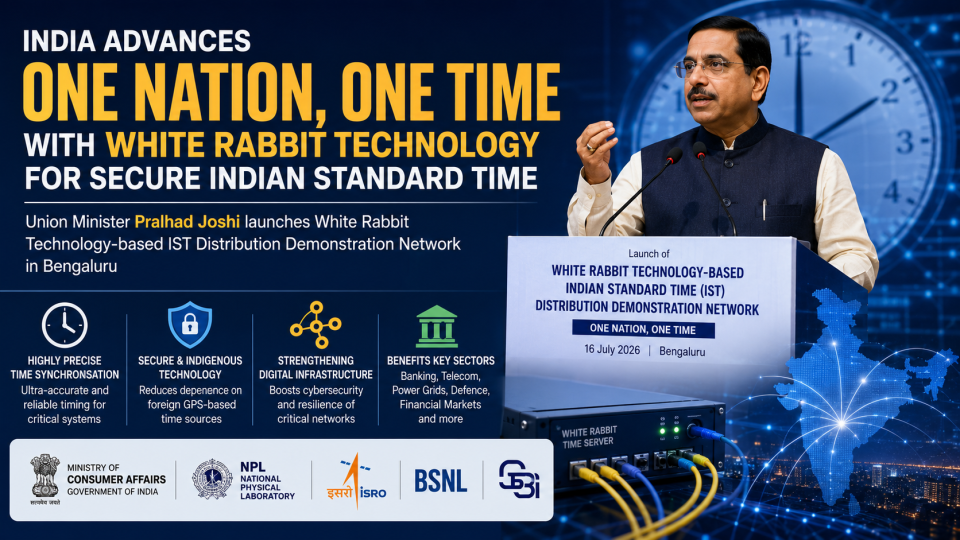
India has taken a major step towards digital time sovereignty with the launch of the White Rabbit Technology-based Indian Standard Time (IST) Distribution Demonstration Network. Inaugurated by Union Minister for Consumer Affairs, Food and Public Distribution, and New and Renewable Energy, Pralhad Joshi, the initiative aims to deliver highly precise, secure and indigenous time synchronisation, reducing dependence on foreign GPS-based time sources and strengthening critical digital infrastructure.
Key Highlights
- Pralhad Joshi launched the White Rabbit Technology-based IST Distribution Demonstration Network in Bengaluru.
- The initiative supports the “One Nation, One Time” vision for precise and secure Indian Standard Time.
- The indigenous system reduces dependence on foreign GPS-based time sources, enhancing digital sovereignty.
- Banking, telecom, power grids, defence and financial markets will benefit from high-precision time synchronisation.
India has moved a step closer to achieving digital time sovereignty with the launch of the White Rabbit Technology-based Indian Standard Time (IST) Distribution Demonstration Network at the Regional Reference Standards Laboratory (RRSL) in Jakkur, Bengaluru. The network was inaugurated by Union Minister Pralhad Joshi under the government’s ambitious “One Nation, One Time” initiative, which seeks to establish a uniform, highly accurate and secure national time standard across the country.
The White Rabbit Technology enables ultra-precise time synchronisation and is designed to eliminate India’s reliance on foreign GPS-based time references. By creating an indigenous time distribution network, the system is expected to significantly improve the resilience of digital banking, stock exchanges, telecommunications, power grids, defence systems and other critical infrastructure against cyber threats, spoofing and data manipulation.
The project is being implemented by the Legal Metrology Division of the Ministry of Consumer Affairs in collaboration with the National Physical Laboratory (NPL), ISRO, BSNL and SEBI. Operating in accordance with Coordinated Universal Time (UTC) standards, the indigenous network combines global interoperability with stronger national control over India’s time infrastructure, supporting secure and transparent digital governance.
Speaking at the launch, the Minister said that uniform time protocols will become a foundational pillar for India’s expanding digital economy and future technology ecosystem. The initiative is expected to strengthen the reliability of financial transactions, public services, telecommunications and critical national infrastructure, while supporting the country’s broader vision of Atmanirbhar Bharat through indigenous technological capabilities.
Conclusion
The launch of the White Rabbit Technology-based IST Distribution Demonstration Network marks a significant milestone in India’s journey towards digital sovereignty and secure time infrastructure. By establishing a precise and indigenous national time distribution system, India is laying the foundation for a safer, more resilient and globally competitive digital ecosystem.
FAQs
1. What is White Rabbit Technology?
White Rabbit Technology is a high-precision time synchronisation system that distributes Indian Standard Time (IST) with extremely high accuracy across digital networks.
2. What is the ‘One Nation, One Time’ initiative?
It is a Government of India initiative aimed at establishing a uniform, secure and precise Indian Standard Time for all critical sectors.
3. Which organisations are involved in the project?
The project is being implemented through collaboration between the Legal Metrology Division, National Physical Laboratory (NPL), ISRO, BSNL and SEBI.
4. Why is this initiative important?
It reduces dependence on foreign GPS-based time sources, enhances cybersecurity and improves the reliability of banking, telecom, defence, power grids and digital governance.
