

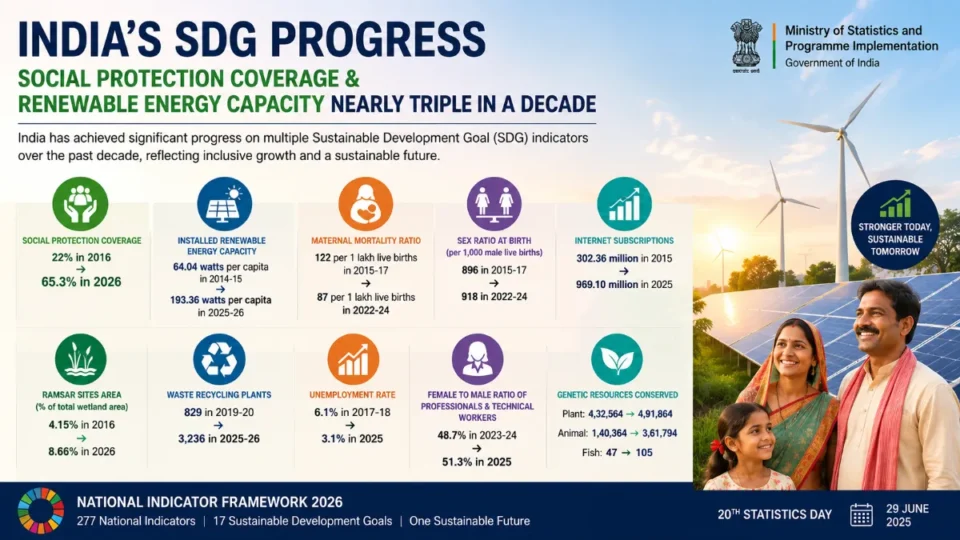
India has recorded significant progress across multiple Sustainable Development Goal (SDG) indicators over the past decade, with social protection coverage increasing from 22% in 2016 to 65.3% in 2026 and installed renewable energy capacity nearly tripling, according to the Ministry of Statistics and Programme Implementation (MoSPI). The latest National Indicator Framework 2026 also highlights improvements in maternal health, employment, internet connectivity and environmental conservation.
Key Highlights
- Social protection coverage increased from 22% in 2016 to 65.3% in 2026.
- Installed renewable energy capacity nearly tripled over the last decade.
- India’s unemployment rate declined to 3.1% in 2025.
- National Indicator Framework 2026 tracks 277 SDG indicators across all 17 Sustainable Development Goals.
India has achieved remarkable progress across several Sustainable Development Goal (SDG) indicators, reflecting the country’s sustained focus on inclusive growth, renewable energy expansion, digital connectivity and environmental sustainability, according to data released by the Ministry of Statistics and Programme Implementation (MoSPI).
The latest National Indicator Framework (NIF) 2026, released on the occasion of 20th Statistics Day, presents 277 national indicators covering all 17 Sustainable Development Goals, offering a comprehensive assessment of India’s development journey over the past decade.
One of the most notable achievements has been the sharp increase in social protection coverage, which expanded from 22 per cent of the population in 2016 to 65.3 per cent in 2026. The improvement reflects wider access to government welfare schemes and social security programmes designed to improve the quality of life for millions of citizens.
India has also made significant strides in renewable energy generation. The country’s installed renewable energy generating capacity increased from 64.04 watts per capita in 2014-15 to 193.36 watts per capita in 2025-26, nearly tripling within a decade and reinforcing India’s commitment to clean energy and climate goals.
The report highlights encouraging progress in public health indicators as well. The Maternal Mortality Ratio (MMR) declined from 122 deaths per one lakh live births during 2015-17 to 87 during 2022-24, while the Sex Ratio at Birth improved from 896 girls per 1,000 boys to 918 girls per 1,000 boys during the same period.
India’s digital transformation has also accelerated significantly. The number of internet subscriptions more than tripled, rising from 302.36 million in 2015 to 969.10 million in 2025, supporting the expansion of digital services, e-governance and financial inclusion.
The country also strengthened its environmental conservation efforts. The area covered under Ramsar sites increased from 4.15 per cent of total wetlands in 2016 to 8.66 per cent in 2026, while the number of waste recycling plants grew from 829 in 2019-20 to 3,236 in 2025-26, reflecting increased emphasis on sustainable waste management.
The report further shows improvements in employment and gender inclusion. India’s unemployment rate declined from 6.1 per cent in 2017-18 to 3.1 per cent in 2025, while the ratio of female to male professionals and technical workers increased from 48.7 per cent to 51.3 per cent, indicating growing participation of women in skilled employment.
In biodiversity conservation, plant genetic resources increased from 4,32,564 to 4,91,864, animal genetic resources rose from 1,40,364 to 3,61,794, and fish genetic resources more than doubled, demonstrating continued efforts to preserve India’s rich biological diversity.
Conclusion
The National Indicator Framework 2026 highlights India’s broad-based progress across social welfare, renewable energy, health, employment, digital infrastructure and environmental conservation. As the country advances towards achieving the Sustainable Development Goals by 2030, these indicators reflect the impact of long-term policy initiatives aimed at building an inclusive, sustainable and resilient economy.
