

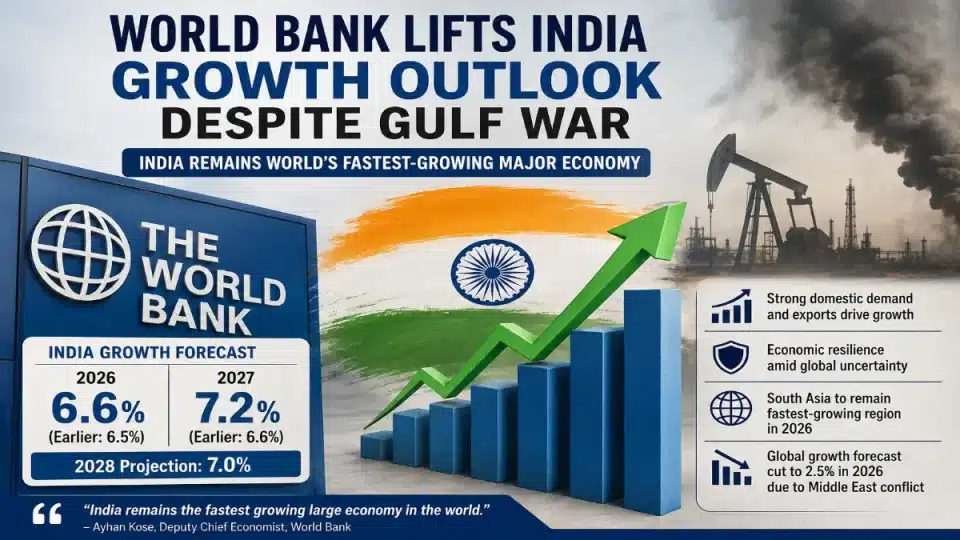
The World Bank has upgraded India’s GDP growth forecast for 2026 to 6.6%, up from its earlier estimate of 6.5%, while raising the 2027 projection to 7.2%. Despite economic uncertainties arising from the Middle East conflict, India remains the world’s fastest-growing major economy, supported by strong domestic demand, exports, and resilient economic fundamentals.
Key Highlights
✅ World Bank raises India’s 2026 GDP growth forecast to 6.6% from 6.5%
✅ India’s 2027 growth projection increased to 7.2% from 6.6%
✅ India remains the fastest-growing major economy globally
✅ Strong domestic demand and exports drive economic resilience
✅ South Asia expected to remain the world’s fastest-growing region in 2026
✅ Global growth forecast cut to 2.5% amid Middle East conflict
✅ India projected to grow 7% in 2028
Wasington, June 12 India will continue to be the world’s fastest-growing major economy despite economic turbulence triggered by the ongoing conflict in the Middle East, with the World Bank upgrading India’s growth outlook while lowering projections for much of the global economy.
Must Read
- India Leads Region with 7.6% Growth as South Asia Slows: World Bank
- India Jumps 79 Places in World Bank Ease of Doing Business Rankings, Says Minister
In its latest Global Economic Prospects Report, the World Bank raised India’s GDP growth forecast for 2026 to 6.6 per cent, up from the 6.5 per cent estimate released in January. The institution also significantly increased its projection for 2027 to 7.2 per cent, compared to the earlier forecast of 6.6 per cent.
Speaking during a media briefing, Ayhan Kose, Deputy Chief Economist at the World Bank, highlighted India’s strong economic performance and resilience amid global uncertainty.
“India remains the fastest growing large economy in the world,” Kose said while discussing the report’s findings.
Responding to a question regarding the impact of the Gulf crisis on India’s economy, Kose noted that the revised forecast was based on stronger-than-expected domestic demand, which has so far offset the adverse effects of geopolitical tensions in the Middle East.
According to the World Bank, India’s economic fundamentals remain robust, providing stability even as rising oil prices and global uncertainty create headwinds for many economies.
“When we look at the big picture for India, there is still incredible dynamism,” Kose remarked, adding that the country has implemented the necessary policy measures to sustain growth.
The report also projects South Asia to remain the fastest-growing region globally in 2026, although regional growth is expected to moderate to 6.3 per cent from 7 per cent in 2025 due to higher energy prices and broader spillover effects from the Middle East conflict.
The World Bank highlighted that India’s growth outlook is being supported by a rebound in domestic consumption and exports, making it one of the few major economies to receive an upward revision in growth estimates.
Meanwhile, the institution warned that the Middle East conflict could slow global growth to 2.5 per cent in 2026, down from 2.9 per cent in 2025, marking the weakest expansion rate since the COVID-19 pandemic. Rising energy costs, inflationary pressures and tighter financial conditions are expected to weigh on economic activity across much of the world.
Despite these global challenges, India’s growth trajectory remains strong. The World Bank expects the country to expand by 7 per cent in 2028, reinforcing its position as a key driver of global economic growth.
The report also noted that growth across developing economies is projected to fall to a post-pandemic low of 3.6 per cent in 2026. Higher energy and fertiliser prices resulting from the Gulf conflict could create additional challenges for many emerging markets, particularly energy-importing nations.
However, India’s combination of resilient domestic demand, export recovery and sound policy measures continues to distinguish it from many global peers, helping maintain investor confidence and supporting long-term economic expansion.
The World Bank’s upward revision of India’s growth forecast underscores the country’s economic resilience amid escalating geopolitical tensions and a slowing global economy. With strong domestic demand, improving exports and supportive policy measures, India remains well-positioned to retain its status as the world’s fastest-growing major economy over the coming years.
FAQ Section
Q1: What is India’s GDP growth forecast for 2026 according to the World Bank ?
The World Bank has raised India’s GDP growth forecast for 2026 to 6.6 per cent.
Q2: Why did the World Bank upgrade India’s growth outlook ?
The upgrade was driven by strong domestic demand, export recovery and economic resilience despite global challenges.
Q3: What is India’s projected growth rate for 2027?
India’s GDP is expected to grow 7.2 per cent in 2027, according to the World Bank.
Q4: How has the Middle East conflict affected global growth projections ?
The World Bank expects global growth to slow to 2.5 per cent in 2026 due to higher oil prices, inflation and tighter financial conditions.
Q5: Is India still the fastest-growing major economy ?
Yes. The World Bank has reaffirmed that India remains the world’s fastest-growing major economy.
