


1005 Ayushman Arogya Mandir (Ayush) Earned NABH Certification in 100 Days: Prataprao Jadhav
Landmark MoU with Malaysia, Ayurveda Chair Operationalized: Ayush Minister
New Delhi, 28 Sep 2024: Minister of State for Ayush (Independent Charge), Prataprao Jadhav, in a media briefing today, highlighted the major achievements of the Ministry of Ayush in its first 100 days. Jadhav stated, “Under the visionary leadership of Prime Minister Narendra Modi the Ministry has made remarkable progress in promoting traditional Indian systems of medicine and strengthening of Ayush in the field of international cooperation”.
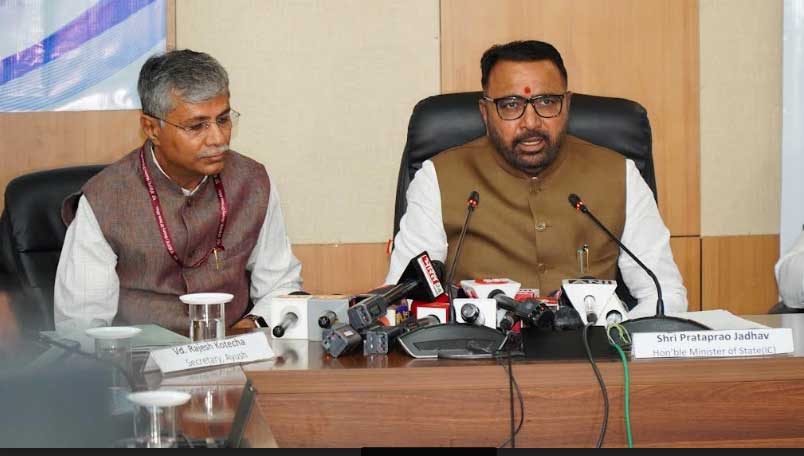
Ayush Minister also stated “The Ministry convened a review meeting to incorporate Ayurvedic packages under the Ayushman Bharat – Pradhan Mantri Jan Arogya Yojana (AB-PMJAY) to incorporate Ayush treatment into mainstream healthcare. Under this 170 packages have been finalized and this number can be increased as per the requirement. To finalize cost structures and guarantee the affordability of Ayush treatments under the program, a Strategic Purchasing Committee has been established.”
Prataprao Jadhav emphasized that Health of each and every citizen of India is important and keeping this in view a special drive has also been initiated to have Prakriti Parikshan of the citizens of India.
Secretary Ayush Vd. Rajesh Kotecha appraised the media of recent developmental activities of 100 Days of Ayush.
Key Achievements of Ayush in 100 Days:
1-Donor Agreement with the World Health Organization (WHO)
A donor agreement was signed by the Ministry of Ayush and WHO on July 31, 2024, at the WHO headquarters in Geneva. This agreement demonstrates India’s dedication to working with international health organizations and improving the integration of Ayush systems into the global healthcare system. The collaboration seeks to provide evidence-based traditional medicine with a stronger foundation.
2. MoU with Vietnam on Medicinal Plants
India and Vietnam inked a Memorandum of Understanding (MoU) centered on cooperation in medicinal plants on August 1, 2024. This agreement signed in the august presence of the Prime Minister Narendra Modi and his Vietnamese counterpart, is a major step toward advancing traditional medicine practices worldwide. To encourage the sharing of information, resources, and research in this area, Vietnam’s Traditional Medicine Administration and India’s National Medicinal Plants Board will collaborate closely.
3 Landmark MoU with Malaysia on Ayurveda
India and Malaysia have taken a significant step in advancing traditional medicine by signing an agreement on Ayurveda. This partnership will promote research, knowledge exchange, and the creation of Ayurvedic treatment regimens. It opens a new chapter in the development of India and Malaysia’s bilateral relations. An Ayurveda Chair has been operationalized at the Universiti Tunku A bdul Rahman(UTAR) as an outcome of the MoU between INSTITUTE OF TEACHING & RESEARCH IN AYURVEDA and Universiti Tunku abdul Rahman(UTAR).
4. Promoting the “One Herb, One Standard” Initiative
On August 6, 2024, the Pharmacopoeia Commission for Indian Medicine & Homoeopathy (PCIM&H) and the Indian Pharmacopoeia Commission (IPC) signed a historic Memorandum of Understanding to carry out the “One Herb, One Standard” initiative with a larger objective to improve quality of medicines in the sector. By standardizing herbal medications, this initiative seeks to increase the efficacy and security of pharmaceuticals throughout India. Aligning with global health standards and bolstering confidence in traditional medicines are crucial goals of this move.
5. Special Medical Stores for Ayush Medicines
To guarantee easy access to Ayush medications, Prataprao Jadhavannounced on August 26, 2024, that the government intended to openspecial medical stores at every tehsil level. Access to a variety ofherbal and traditional medicines will be made possible by thesestores, improving public healthcare in both urban and rural areas.
6. NABH evaluation of 1489 Ayushman Arogya Mandir (Ayush) completed
According to the report received from the National Accreditation Board for Hospitals and Healthcare Providers (NABH), the evaluation of 1489 Ayushman Arogya Mandir (Ayush) has been completed, and 1005 of these AAM (Ayush) have been certified for Ayush Entry Level Certification (AELC). This initiative is an important step in ensuring quality healthcare services under the National Ayush Mission.
Major Campaigns and Initiatives:
7. “Har Ghar AyurYog” Campaign for a Healthier India
The “Har Ghar AyurYog” initiative was started by the Ministry with the goal of increasing the uptake of Ayurveda and Yoga in communities. Including yoga in the Fit India School certification is one of the highlights. “Bharat Ka Prakriti Parikshan” abhiyan to be at the core of the initiative and the broad roadmap to involve stakeholders across the country has been prepared.
8. Ayush Camps for Geriatric Population
Ministry of Ayush committed to organise 10,000 camps for elderly citizens within the time frame of 100 days. Beating the target, 14,692 Ayush camps were organised around the country in a massive outreach effort to meet the healthcare needs of the elderly. Free consultations, therapies, and guidance on holistic health using Ayurveda, Yoga, Unani, Siddha, and homoeopathy were offered at these camps.
9. Centers of Excellence in Ayush
In partnership with esteemed establishments like IISc Bangalore, IIT Delhi, TMC Mumbai, and JNU New Delhi, six new Centers of Excellence were founded. These centers, which have been granted ₹52.47 crore in funding, will concentrate on cutting-edge traditional medicine research, teaching, and healthcare innovation.
10. Inclusion of Ayush Packages in AB-PMJAY
The Ministry convened a review meeting to incorporate Ayurvedic packages under the Ayushman Bharat – Pradhan Mantri Jan Arogya Yojana (AB-PMJAY) to incorporate Ayush treatment into mainstream healthcare. To finalize cost structures and guarantee the affordability of Ayush treatments under the program, a Strategic Purchasing Committee has been established.
11. Phase II of All India Institute of Ayurveda
(AIIA), New Delhi
AIIA Phase II to be an advanced center for Ayurvedic research and treatment. A 194-bed hospital, an Ayurvedic Sports Medicine Complex, and Panchkarma treatment rooms are among the amenities included in this phase. At a total cost of ₹289.05 crore, the project will greatly improve Ayurvedic research and training capabilities.
12. National Institute of Ayurveda, Panchkula, Haryana
The National Institute of Ayurveda coming up in Panchkula, Haryana, with a ₹294.91 crore investment. This institute will function as a top-tier teaching and research facility with a
250-bed hospital and undergraduate, graduate, and doctorate programs in Ayurveda.
13. Three Central Research Institutes on Yoga and Naturopathy
The preliminary process for establishing three Central Research Institutes for Yoga and Naturopathy (CRIYN) in Odisha, Chhattisgarh, and Andhra Pradesh has been completed.
Swachhata Campaign:
The Swachhata Hi Sewa (SHS) 2024 campaign, which focused on cleanliness drives and citizen participation and was co-organized by SBM-Gramin and SBM-Urban saw active participation from the Ministry.
Important highlights consist of
Swachhata Mein Jan Bhaagidari: encouraging communal and individualcleanliness via pledges, contests, and planting campaigns.
Mega Cleanliness Drives: These campaigns focus on making public areas like roads, train stations, and bodies of water clean and aesthetically pleasing while paying special attention to removing stains.
*Safai Mitra Suraksha Shivirs: Health and welfare camps that provide preventive healthcare and connect sanitation workers with government welfare programs.
Minister, Prataorao Jadhav further stated, ‘Under the leadership of the Prime Minister Narendra Modi and the support of all Ayush team members and stakeholders, during the first 100 days of current government we have laid a solid foundation for the advancement of traditional medicine both domestically and internationally.
The accomplishments of the Ministry, ranging from global partnerships to extensive domestic endeavors, demonstrate its dedication to enhancing public health via Ayush systems. These programs are significant steps in the direction of creating a healthier and wealthier India.
