

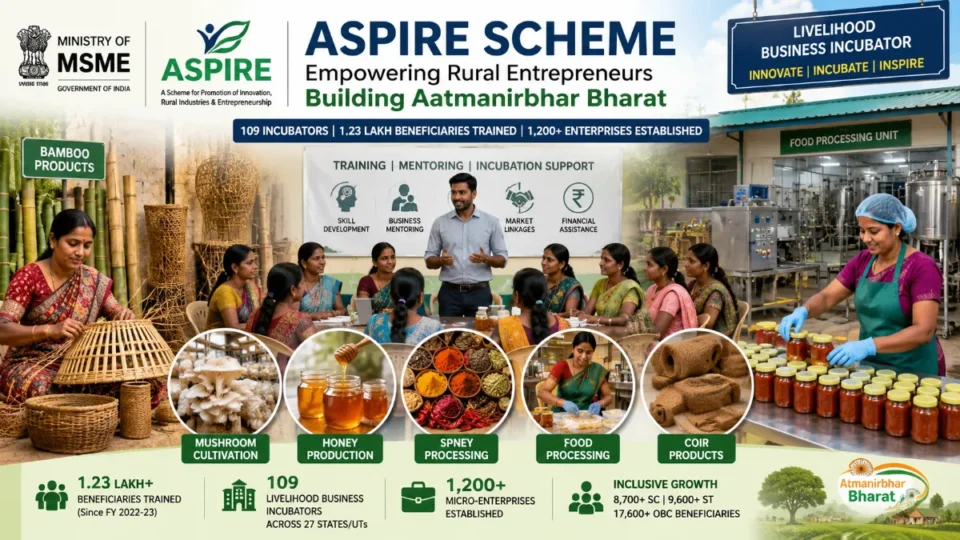
The Ministry of MSME‘s ASPIRE (A Scheme for Promotion of Innovation, Rural Industries and Entrepreneurship) has approved 109 Livelihood Business Incubators (LBIs) across 27 States and Union Territories, trained over 1.23 lakh beneficiaries, and supported the creation of more than 1,200 micro-enterprises since FY 2022-23. The initiative is strengthening rural entrepreneurship, employment generation, and innovation in agro-based sectors across India. This initiative is part of the efforts as the Govt approves 109 ASPIRE incubators.
Key Highlights
Additionally, the program emphasizes the importance of sustainable practices in entrepreneurship as the Govt approves 109 ASPIRE incubators.
This initiative further highlights how the Govt approves 109 ASPIRE incubators to foster innovation and growth in rural areas.
- 109 Livelihood Business Incubators approved across 27 States and Union Territories.
- More than 1.23 lakh beneficiaries trained under the ASPIRE scheme.
- Over 1,200 micro-enterprises established through ASPIRE-supported incubators since FY 2022-23.
- The scheme has benefited SC, ST and OBC entrepreneurs, promoting inclusive rural entrepreneurship.
The Ministry of Micro, Small and Medium Enterprises (MSME) is strengthening India’s rural entrepreneurship ecosystem through its flagship ASPIRE (A Scheme for Promotion of Innovation, Rural Industries and Entrepreneurship) programme. According to an official statement issued on Friday, the scheme has approved 109 Livelihood Business Incubators (LBIs) across 27 States and Union Territories, helping thousands of aspiring entrepreneurs transform business ideas into sustainable enterprises.
Since systematic monitoring of the programme began in FY 2022-23, ASPIRE-supported incubators have trained more than 1.23 lakh beneficiaries and facilitated the establishment of over 1,200 micro-enterprises across the country. The initiative reflects the government’s continued focus on promoting self-employment, innovation, and inclusive economic development in rural India.
Launched in 2015, the ASPIRE Scheme aims to generate employment and encourage entrepreneurship, particularly in rural and agro-based sectors. The programme functions through a growing network of Livelihood Business Incubators, which help individuals move from skill development to establishing successful enterprises.
The incubators support businesses across a wide range of sectors, including food processing, honey production, bamboo products, mushroom cultivation, spice processing, handicrafts, and coir products. Entrepreneurs receive training, mentoring, incubation support, access to modern equipment, technology assistance, branding support, product development, regulatory guidance, accreditation, market linkages, and financial access, enabling them to build sustainable businesses.
The government highlighted that ASPIRE has significantly contributed to inclusive entrepreneurship, benefiting more than 8,700 Scheduled Caste (SC) beneficiaries, over 9,600 Scheduled Tribe (ST) beneficiaries, and more than 17,600 Other Backward Class (OBC) beneficiaries.
The scheme follows a three-tier implementation structure consisting of the Scheme Steering Committee, Mentor Institutes, and Host Institutions operating the incubators. Mentor Institutes identify suitable incubators, prepare project proposals, design incubation programmes, strengthen implementation, and monitor project outcomes.
Several leading institutions are supporting the programme, including the Indian Institute of Entrepreneurship (IIE), Guwahati, agricultural universities, technical institutions, and premier institutes such as IIT Jodhpur.
The government also cited the success story of Banshailang Marbaniang from Mawsynram, Meghalaya, who established a food-processing enterprise after receiving training from IIE Guwahati. His entrepreneurial journey earned him an invitation to the Republic Day celebrations at Kartavya Path as one of ten entrepreneurs from the North-East recognised for their achievements.
With expanding incubation infrastructure and focused support for rural innovators, the ASPIRE Scheme continues to strengthen India’s MSME ecosystem while promoting entrepreneurship, job creation, and sustainable rural development.
Conclusion
The ASPIRE Scheme has emerged as a key driver of rural entrepreneurship by providing incubation, mentoring, technology, and financial support to aspiring entrepreneurs. With 109 incubators, 1.23 lakh trained beneficiaries, and over 1,200 enterprises established, the programme is playing an important role in strengthening India’s MSME sector and creating sustainable livelihood opportunities across rural and agro-based industries.
Frequently Asked Questions (FAQs)
Q1. What is the ASPIRE Scheme ?
The ASPIRE Scheme is a flagship initiative of the Ministry of MSME, launched in 2015 to promote entrepreneurship and employment generation in rural and agro-based sectors.
Q2. How many incubators have been approved under ASPIRE ?
The government has approved 109 Livelihood Business Incubators (LBIs) across 27 States and Union Territories
Q3. How many people have benefited from the ASPIRE Scheme ?
More than 1.23 lakh beneficiaries have received training under the scheme since systematic monitoring began in FY 2022-23.
Q4. Which sectors are supported under ASPIRE ?
The scheme supports enterprises in food processing, bamboo products, honey production, mushroom cultivation, handicrafts, spice processing, coir products, and other agro-based industries.
Q5. How does ASPIRE help entrepreneurs ?
It provides training, mentoring, incubation support, technology access, branding, product development, market linkages, regulatory guidance, and financial assistance to help entrepreneurs establish and grow their businesse
