

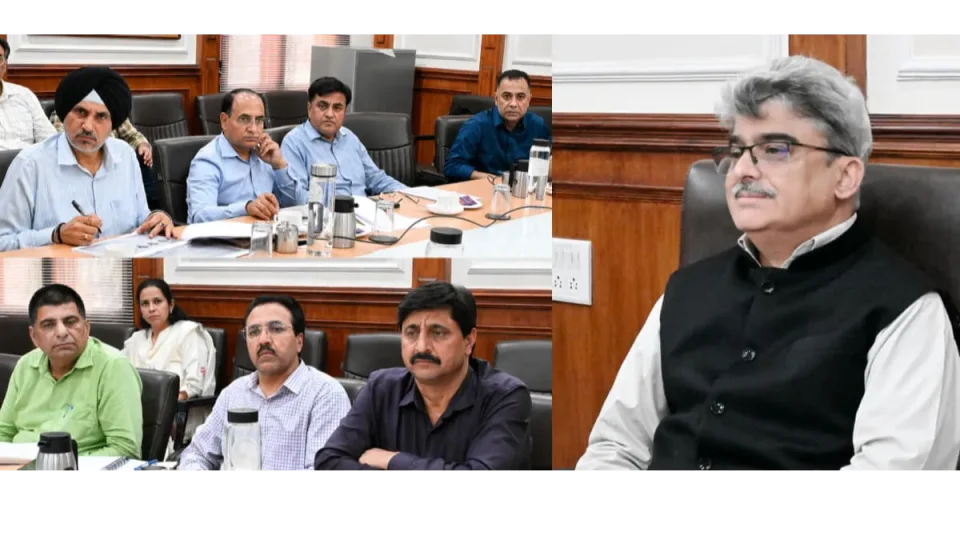
Jammu, April 23: Atal Dulloo chaired a high-level review in Jammu and Kashmir to accelerate the promotion of the handicrafts and handloom sector, with a strategic focus on skilling, GI tagging, credit access, and infrastructure development.
The Chief Secretary directed the immediate operationalisation of non-functional training centres across districts, aligning them with the National Skills Qualification Framework (NSQF) to enhance certification recognition and strengthen workforce capabilities.
He also emphasised scaling up artisan registrations on the Udyam Portal and linking beneficiaries to the Unified Lending Interface (ULI) to improve access to affordable credit.
To further support financial inclusion, the administration is exploring sector-specific term loan products on the lines of agriculture financing, aimed at enabling capital infusion and business expansion for artisans.
Collaboration with National Institute of Fashion Technology (NIFT) is being expanded to deliver short-term and diploma programmes that integrate modern technology with traditional craftsmanship.
On product authenticity and traceability, the government stressed full operationalisation of QR-based GI management systems, integrated with the MeghRaj Cloud, while expediting implementation of the Tex-RAMPS Scheme to strengthen sectoral infrastructure.
Officials highlighted that over 4.52 lakh artisans and weavers are now registered across the Union Territory, with around 12,600 individuals trained through departmental centres. GI certification efforts have also gained momentum, with nearly 4,700 authorised users and over 80,000 products QR-labelled—positioning J&K as the only region in India with GI tags across its full range of traditional crafts.
Infrastructure initiatives include the development of craft villages, common facility centres for wool processing and dyeing, and modernisation of institutions such as the Indian Institute of Carpet Technology. New cluster-based projects and urban haats are also being planned to enhance market access and value addition.
Financial inclusion schemes such as the Artisan Credit Card programme have sanctioned over 2,400 cases, while the Karkhandar scheme has supported the establishment of 46 production units.
The review also covered upcoming large-scale infrastructure projects, including two PM Ekta Unity Malls in Srinagar and Jammu, each with an estimated investment of ₹100 crore, aimed at promoting local crafts and boosting tourism-linked economic activity.
The roadmap reflects a comprehensive strategy to modernise the sector, enhance competitiveness, and drive inclusive growth while preserving the region’s rich artisanal heritage.
Related posts :
 MahaRERA chief Manoj Saunik outpaces his predecessor in speedy disposal of complaints
 Vijay Rupani’s mortal remains to be flown to Rajkot today, Gujarat observes 1-day state mourning
 Rains lash Delhi-NCR, residents get relief from scorching heat
 Centre okays Rs 2,006 crore fund to help Himachal recover from floods, landslides
 History Already Created: Yoga Sangam Event Registrations Surpass 4 Lakh mark
