

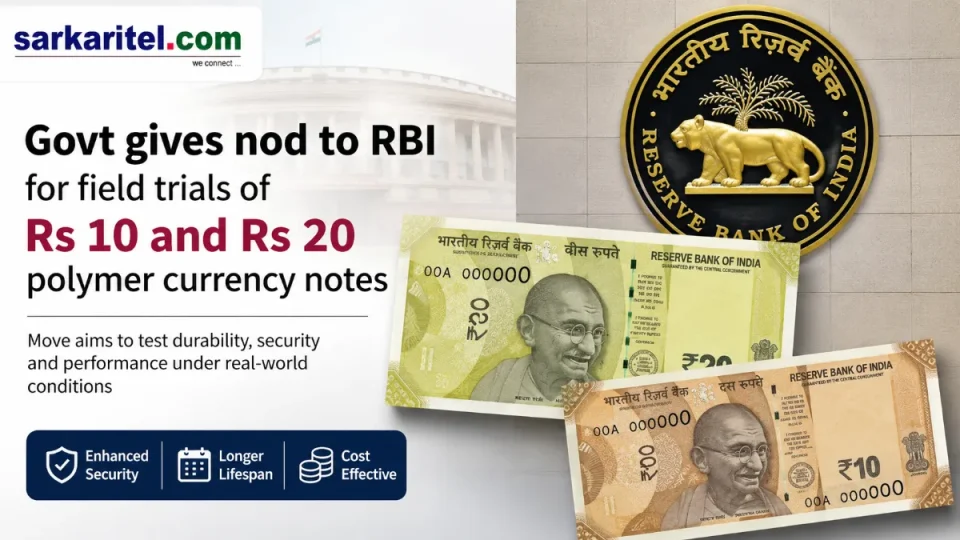
The Government of India has approved the Reserve Bank of India (RBI) to conduct field trials of ₹10 and ₹20 polymer currency notes. The pilot project aims to assess the durability and performance of polymer banknotes under Indian conditions, while the government has clarified that paper currency will continue alongside polymer notes.
Key Highlights
- Government approves RBI field trials for ₹10 and ₹20 polymer currency notes.
- One billion notes each of ₹10 and ₹20 will be issued for the pilot.
- Polymer notes offer greater durability and enhanced anti-counterfeiting features.
- Government says there is no proposal to replace paper currency with polymer banknotes.
New Delhi, July 27: The Finance Ministry on Monday informed Parliament that the Government of India has approved the Reserve Bank of India’s (RBI) proposal to conduct field trials of ₹10 and ₹20 polymer currency notes. In a written reply to the Lok Sabha, Minister of State for Finance Pankaj Chaudhary said the central bank will introduce the polymer notes on a trial basis to evaluate their performance under Indian operating conditions. The government clarified that the initiative is intended to assess the feasibility of polymer banknotes and does not signal the replacement of existing paper currency.
According to the proposal, the RBI will issue one billion ₹10 polymer notes and one billion ₹20 polymer notes during the field trial phase. The pilot project will examine factors such as durability, circulation performance, handling characteristics and public acceptance across different climatic and usage conditions in India. A nationwide rollout will be considered only if the trial demonstrates satisfactory results. The Finance Ministry reiterated that paper-based banknotes and polymer banknotes are expected to coexist, with no proposal currently under consideration to phase out conventional currency.
The Reserve Bank of India has highlighted several advantages of polymer banknotes based on international experience. Polymer notes generally have a longer lifespan than traditional paper notes, making them particularly suitable for lower denominations that experience frequent circulation and wear. The longer durability can reduce the need for repeated printing and destruction of worn-out notes, lowering replacement costs and reducing waste. In addition, polymer substrates enable the incorporation of advanced security features, including transparent see-through windows, specialised security threads and improved anti-counterfeiting technology, enhancing the integrity of the currency system.
The RBI also informed the government that it is too early to assess the impact of polymer notes on digital payments, as such an evaluation would only be possible after the currency enters regular circulation. The central bank maintained that physical cash and digital payment systems complement each other and are expected to continue coexisting in India’s payment ecosystem. The proposed field trials represent an important step in modernising India’s currency management while ensuring greater durability, security and efficiency in the country’s cash circulation system.
The approval for ₹10 and ₹20 polymer currency note trials marks a significant step in evaluating more durable and secure banknotes. However, the government has made it clear that paper currency will remain in circulation, with any broader adoption dependent on the success of the RBI’s field trials.
