

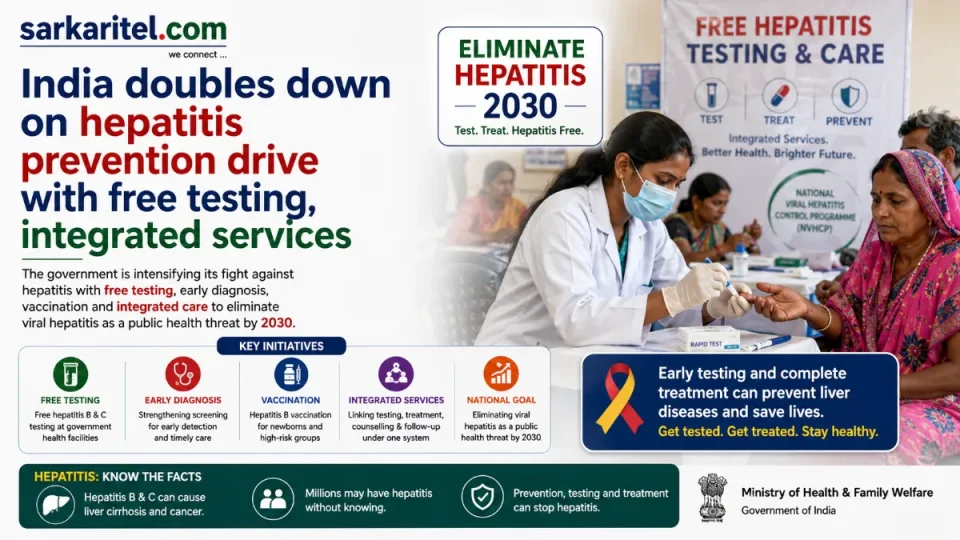
India is accelerating its fight against viral hepatitis by expanding free screening, diagnostics and treatment under the National Viral Hepatitis Control Program (NVHCP). The integrated healthcare initiative aims to eliminate hepatitis as a public health threat by 2030, while improving access to preventive and curative services nationwide.
Key Highlights
- NVHCP expands free hepatitis screening, diagnostics and treatment across India.
- Programme integrates with national health schemes to achieve the 2030 hepatitis elimination goal.
- Free treatment available for hepatitis B and hepatitis C patients.
- Universal hepatitis B screening for pregnant women and birth-dose vaccination strengthened.
New Delhi, July 27: India has intensified its efforts to eliminate viral hepatitis as a public health threat by strengthening the National Viral Hepatitis Control Program (NVHCP) and integrating it with multiple national healthcare initiatives. According to the government, the programme is expanding free screening, diagnosis and treatment services while improving awareness and access to healthcare across the country. Launched in 2018, the NVHCP aligns with the United Nations Sustainable Development Goals (SDGs) and aims to achieve the national target of eliminating viral hepatitis by 2030 through comprehensive preventive, promotive and curative interventions.
The National Viral Hepatitis Control Program covers hepatitis A, B, C, D and E, providing integrated services through a paperless NVHCP Management Information System (MIS) portal that enables efficient patient registration, monitoring and treatment. While hepatitis A and E are primarily acute infections monitored through the Integrated Disease Surveillance Programme (IDSP), the government offers free diagnostics and medicines for patients suffering from hepatitis B and hepatitis C. The programme focuses on increasing awareness, ensuring early diagnosis and making quality healthcare services accessible to every eligible citizen, particularly vulnerable and high-risk populations.
The government has also strengthened maternal and child health interventions to prevent hepatitis transmission. Under the programme, all pregnant women are encouraged to undergo hepatitis B screening, while the Universal Immunisation Programme (UIP) ensures that every newborn receives the hepatitis B birth dose within 24 hours of birth. In cases where mothers test positive for hepatitis B, newborns are also provided Hepatitis B Immunoglobulin (HBIG) to reduce the risk of mother-to-child transmission. According to 2021 HIV Sentinel Surveillance data, around 0.85% of individuals tested positive for hepatitis B and 0.29% for hepatitis C, highlighting the continued need for widespread screening and timely treatment.
To improve public awareness and healthcare access, the government has established a toll-free helpline (1800-11-6666), shared with the National Tuberculosis Elimination Programme (NTEP), to provide information on hepatitis prevention, symptoms, transmission, diagnosis and treatment facilities. By integrating hepatitis services with existing public health programmes, expanding free healthcare access and promoting universal immunisation, India is building a stronger healthcare system capable of significantly reducing the burden of viral hepatitis and moving closer to its 2030 elimination target.
India’s expanded National Viral Hepatitis Control Program reflects a comprehensive approach to eliminating viral hepatitis through free healthcare services, early diagnosis, universal immunisation and integrated public health interventions aimed at achieving the 2030 elimination goal.
