

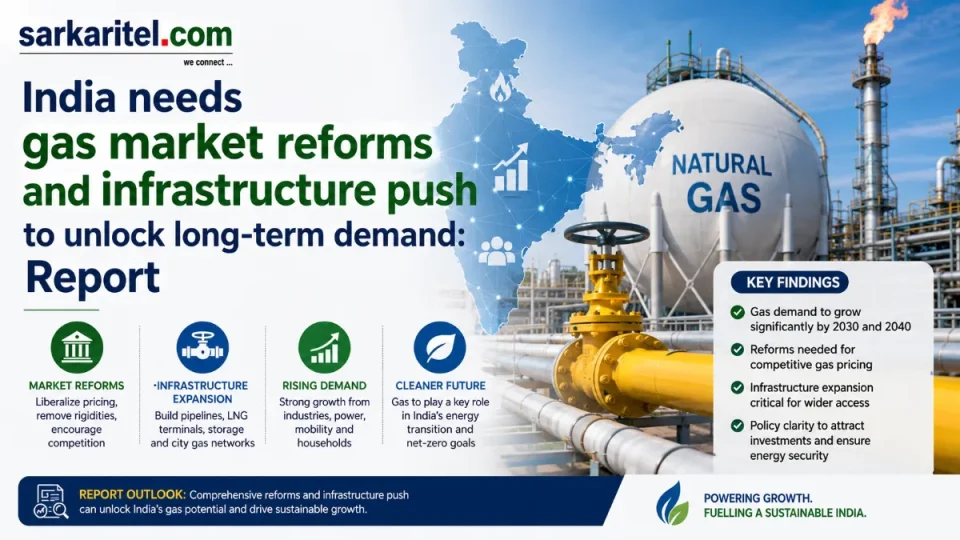
India must accelerate gas market reforms, expand pipeline and distribution infrastructure, and strengthen demand from gas-intensive industries to unlock long-term natural gas growth, according to a new International Gas Union (IGU) report. The study also highlights India’s import dependence and the need for pricing and regulatory reforms.
Key Highlights
- IGU calls for gas market reforms to boost India’s long-term natural gas demand.
- Report urges faster investment in gas transmission and distribution infrastructure.
- India remains heavily dependent on LNG imports, especially from Qatar.
- Strait of Hormuz disruptions expose India’s energy security vulnerabilities.
New Delhi, July 27: India’s long-term natural gas growth will depend on comprehensive gas market reforms, stronger infrastructure investment and greater demand from energy-intensive industries, according to a new report by the International Gas Union (IGU). While the country has significantly expanded its Liquefied Natural Gas (LNG) regasification capacity, the report notes that investment in midstream infrastructure, including gas transmission pipelines and distribution networks, has lagged behind. This imbalance has constrained the expansion of domestic gas consumption and limited the full utilisation of existing import capacity. The report recommends reforms in gas pricing mechanisms, market access and commercial regulations to create a more competitive and efficient natural gas market.
The IGU report highlights India’s continued reliance on imported natural gas despite efforts to boost domestic production. According to the study, domestic gas production currently meets only about 50–52% of national demand, with the remaining requirement fulfilled through LNG imports from Qatar, Australia, the United States and Russia. India’s dependence on imported LPG is even higher, with nearly 60–65% of domestic demand met through overseas supplies. The report states that increasing domestic demand for cleaner fuels will require reliable infrastructure, transparent market rules and policy certainty to attract long-term investment across the gas value chain.
The report also underlines the strategic risks associated with India’s energy imports. The recent Strait of Hormuz crisis demonstrated the country’s vulnerability to disruptions in global energy supply chains because a significant portion of India’s LNG and LPG imports passes through this critical maritime route. As Qatar remains India’s largest LNG supplier, any geopolitical tensions in the Gulf region can directly affect energy availability, import costs and overall energy security. The report stresses that improving supply diversification and strengthening domestic gas infrastructure will be essential to reducing such risks in the future.
Looking ahead, the IGU expects India’s natural gas outlook to improve if geopolitical tensions in the Gulf ease. A substantial wave of new global LNG export capacity expected during the remainder of the decade could increase supply, reduce international LNG prices and improve the affordability of natural gas in India. The report also notes that weaker demand across several Asian markets after recent price volatility may further lower regional LNG benchmark prices, creating favourable conditions for expanding gas consumption. Combined with timely policy reforms and infrastructure development, these trends could accelerate India’s transition towards a cleaner and more resilient energy system.
The IGU report suggests that gas market reforms, expanded infrastructure and competitive pricing will be crucial for unlocking India’s long-term natural gas potential while strengthening energy security and supporting the country’s clean energy transition.
