

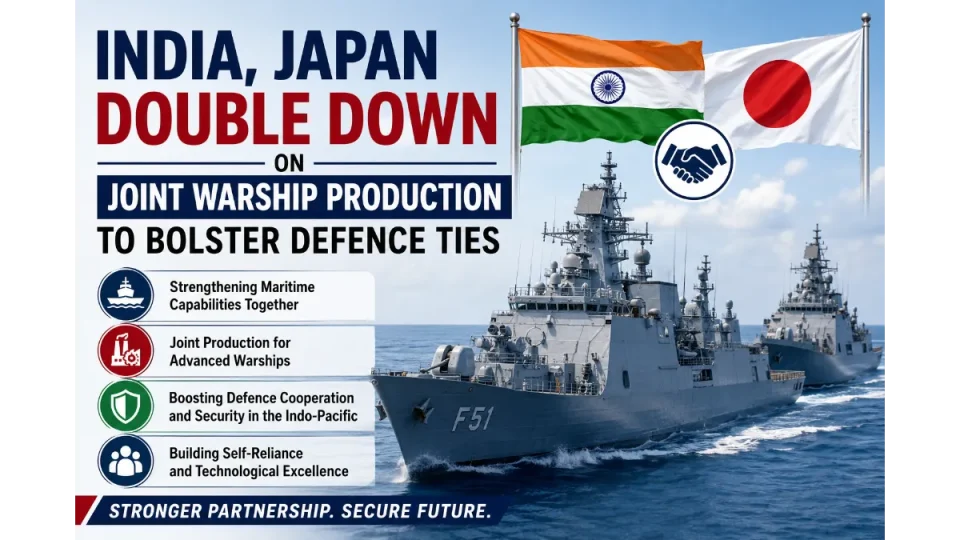
India and Japan are intensifying defence cooperation by exploring joint warship production and advanced naval technologies. A new report says collaboration on Mogami-class frigates and Japan’s UNICORN mast technology could strengthen maritime security, boost indigenous shipbuilding and reinforce a free and open Indo-Pacific.
Key Highlights
- India and Japan are exploring joint warship production to deepen defence cooperation.
- UNICORN mast technology transfer marks a major milestone in defence industrial collaboration.
- Mogami-class frigates are under discussion for joint development and production.
- Partnership supports Aatmanirbhar Bharat and strengthens Indo-Pacific maritime security.
New Delhi, July 24: India and Japan are taking their defence partnership to a new level by exploring joint warship production, reflecting the growing strategic importance of maritime cooperation amid evolving security challenges in the Indo-Pacific. According to a report published in The Diplomat, both countries are increasingly focusing on co-development, advanced naval technologies and defence manufacturing to enhance regional maritime capabilities.
A key milestone in this expanding partnership is the transfer of Japan’s Unified Complex Radio Antenna (UNICORN) mast technology to the Indian Navy. The report notes that this agreement demonstrates the ability of both countries to move beyond a traditional buyer-seller relationship towards joint defence production, creating opportunities for deeper collaboration in naval shipbuilding.
The report also highlights discussions on the joint development of Japan’s advanced Mogami-class frigates, regarded as one of the world’s most modern multi-mission warships. Equipped with stealth features, advanced automation and anti-submarine warfare capabilities, the frigates could significantly enhance India’s indigenous naval shipbuilding programme while supporting the goals of Aatmanirbhar Bharat.
The need for expanding India-Japan defence industrial cooperation gained further momentum during Japanese Prime Minister Sanae Takaichi’s recent visit to India. The report states that joint shipbuilding would create long-term industrial partnerships spanning advanced manufacturing, artificial intelligence, propulsion systems, maritime electronics and maintenance ecosystems, strengthening both military readiness and economic resilience.
For India, access to Japanese maritime technologies would accelerate the development of next-generation naval platforms. At the same time, Japan would benefit by expanding production through collaboration with India’s growing defence manufacturing ecosystem, helping its defence industry overcome the limitations of a relatively small domestic market and improve supply-chain resilience.
Beyond industrial cooperation, the report says India-Japan joint shipbuilding would reinforce the regional maritime balance by improving interoperability in anti-submarine warfare, humanitarian assistance, disaster relief operations and protection of critical sea lanes. As both nations share a commitment to freedom of navigation, international law and a rules-based Indo-Pacific, closer naval cooperation is expected to strengthen long-term regional security.
The proposed India-Japan collaboration on warship production has the potential to transform bilateral defence ties by combining advanced Japanese technology with India’s manufacturing capabilities, while reinforcing maritime security and stability across the Indo-Pacific.
