

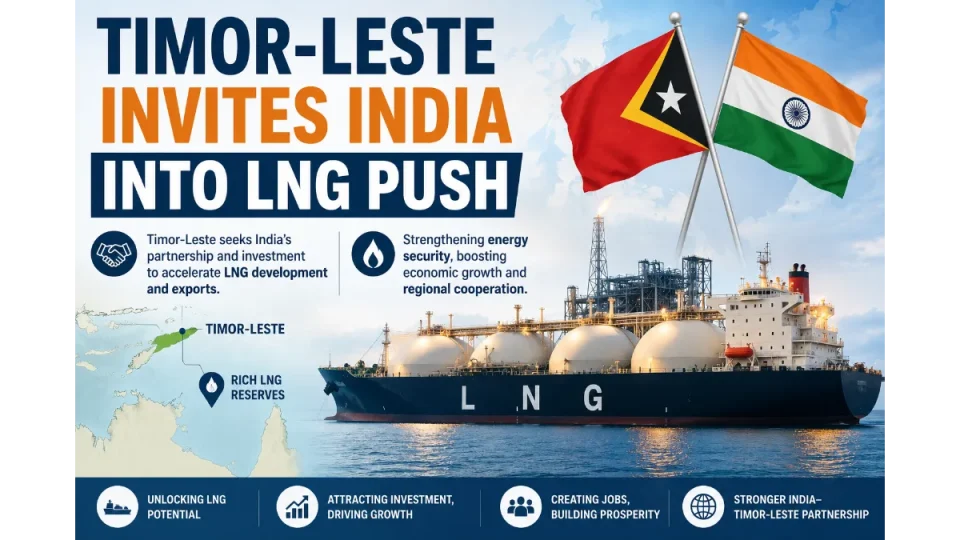
Timor-Leste has invited Indian companies to invest in liquefied natural gas (LNG), oil refining, pipelines and education, as the Southeast Asian nation seeks to deepen economic ties with India. Ambassador Jose Luis Guterres said energy, infrastructure and human resource development offer significant opportunities for bilateral cooperation.
Key Highlights
- Timor-Leste has invited Indian investment in LNG, oil refining, pipelines and education.
- The Greater Sunrise gas field holds an estimated five trillion cubic feet of natural gas reserves.
- The country expects stronger economic ties following the opening of embassies in New Delhi and Dili.
- Education, healthcare and coffee trade have also emerged as promising areas of India-Timor-Leste cooperation.
Washington, July 22: Timor-Leste is looking to strengthen its economic partnership with India by inviting investments in liquefied natural gas (LNG), oil refining, pipeline infrastructure and education, according to Ambassador Jose Luis Guterres, the country’s Ambassador to the United States and former Deputy Prime Minister and Foreign Minister.
In an exclusive interaction, Guterres said energy remains one of the most promising sectors for Indian investors. Timor-Leste possesses significant oil and natural gas reserves and is seeking international partners to develop an LNG processing plant, oil refineries and a pipeline connected to the Greater Sunrise gas field, one of the country’s most important offshore energy assets.
According to the ambassador, the Greater Sunrise gas field contains an estimated five trillion cubic feet of natural gas reserves, sufficient to support nearly 30 years of production. He emphasised that Timor-Leste is actively encouraging investments from India, the United States and other countries, adding that the nation is “open for business.”
Guterres said the recent opening of Timor-Leste’s Embassy in New Delhi and India’s diplomatic mission in Dili would further strengthen bilateral economic engagement and facilitate greater business cooperation. He also expressed hope that Prime Minister Narendra Modi would visit Timor-Leste to further deepen strategic ties.
The ambassador said bilateral relations received a significant boost following President Droupadi Murmu’s historic visit to Timor-Leste in August 2024, describing it as “like a family visit.” He said the visit marked a new phase in India-Timor-Leste relations and reinforced the longstanding friendship between the two countries.
Highlighting India’s regional role, Guterres said Timor-Leste considers India a natural partner in the Indo-Pacific, rather than an external power. He praised Prime Minister Modi’s leadership and India’s contribution towards regional peace, stability and democratic values, adding that India and the United States, working alongside ASEAN countries, can help maintain a stable environment for economic growth.
Beyond energy, the ambassador identified education as another promising area of collaboration. He noted that an Indian investor has partnered with a Catholic university in Timor-Leste to strengthen medical education, while Indian students are already pursuing medical studies in the country. He also highlighted coffee exports as an area with untapped potential, noting that Timorese organic coffee is exported to markets including the United States, Australia, Japan and Germany, and has also been promoted in India by President José Ramos-Horta.
India and Timor-Leste established diplomatic relations in January 2003. President Murmu’s 2024 visit—the first by an Indian Head of State—focused on cooperation in digital technology, healthcare, agriculture and capacity building. Timor-Leste further strengthened its regional engagement by becoming the 11th member of ASEAN in October 2025, opening new avenues for economic and strategic cooperation with India.
Timor-Leste’s invitation to Indian businesses reflects its ambition to diversify investments and strengthen partnerships in energy, infrastructure, education and trade. With abundant natural gas reserves, expanding diplomatic engagement and ASEAN membership, the country presents new opportunities for Indian companies seeking to expand their presence in Southeast Asia.
