

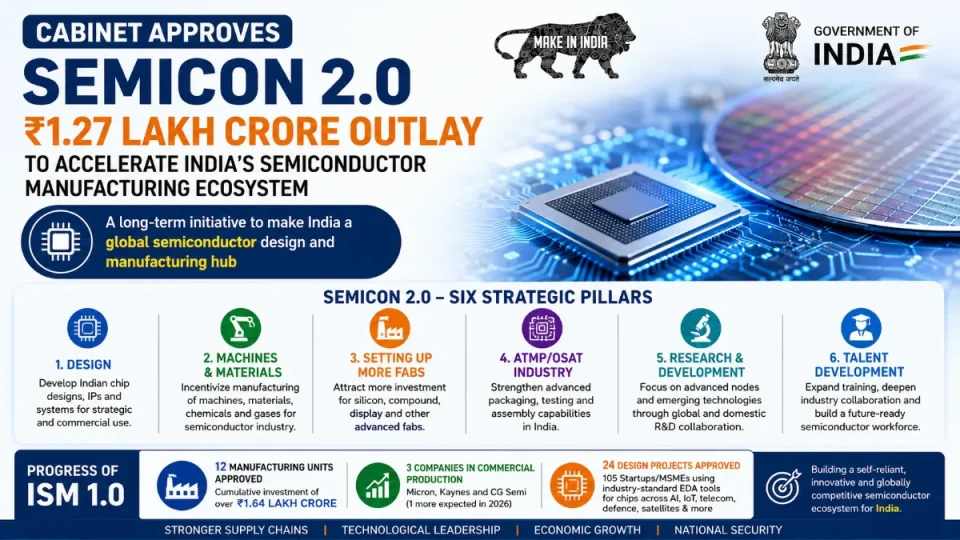
The Union Cabinet has approved Semicon 2.0 with a budgetary outlay of ₹1,27,500 crore to strengthen India’s semiconductor ecosystem through investments in chip design, fabrication, packaging, R&D, talent development and supply chains. The long-term initiative aims to position India as a global semiconductor manufacturing and innovation hub.
Key Highlights
- Union Cabinet approves Semicon 2.0 with an outlay of ₹1.27 lakh crore.
- Scheme focuses on six pillars, including chip design, fabs, R&D, ATMP/OSAT and talent development.
- 12 semiconductor manufacturing projects worth over ₹1.64 lakh crore have already been approved under Semicon 1.0.
- Initiative aims to strengthen India’s semiconductor manufacturing, innovation, exports and supply chain resilience.
The Union Cabinet, chaired by Prime Minister Narendra Modi, has approved Semicon 2.0 with a total budgetary outlay of ₹1,27,500 crore, reinforcing the Government’s long-term commitment to building a globally competitive semiconductor design and manufacturing ecosystem. The programme builds upon the progress made under Semicon 1.0 and seeks to establish India as a trusted destination for semiconductor innovation, manufacturing and advanced technology development.
The ambitious initiative is structured around six strategic pillars—chip design, semiconductor machines and materials, fabrication plants (fabs), ATMP/OSAT packaging facilities, research & development, and talent development. The Government will continue supporting Indian startups developing semiconductor intellectual property (IP) while encouraging investments in semiconductor equipment, specialty materials, chemicals and gases that are essential for advanced chip manufacturing. The scheme also aims to attract additional global investments in silicon fabs, compound semiconductor fabs, discrete component fabs and display fabs.
A major focus of Semicon 2.0 is to strengthen India’s position across the entire semiconductor value chain. The programme will incentivise companies setting up advanced ATMP (Assembly, Testing, Marking and Packaging) and OSAT (Outsourced Semiconductor Assembly and Test) facilities while supporting next-generation semiconductor research through collaborations with leading national and international R&D institutions. Simultaneously, the Government plans to expand semiconductor education by deepening industry-academia partnerships, with 315 universities already training nearly 68,000 students using industry-standard Electronic Design Automation (EDA) tools.
The achievements under Semicon 1.0 have laid a strong foundation for the new programme. The Government has already approved 12 semiconductor manufacturing projects involving investments of more than ₹1.64 lakh crore, including one silicon fab, one silicon carbide fab, one integrated Gallium Nitride Micro LED Display Fab and nine semiconductor packaging units. Companies such as Micron, Kaynes and CG Semi have already started commercial production, while another manufacturing facility is expected to become operational during 2026. Additionally, 24 semiconductor design projects have received financial support, while 105 startups and MSMEs are actively designing chips for AI, IoT, telecom, defence, satellite communications, surveillance systems and smart electronics, further strengthening India’s semiconductor capabilities.
Semicon 2.0 marks a transformative phase in India’s technology and manufacturing journey. By promoting semiconductor design, advanced manufacturing, research, innovation and skilled talent, the initiative is expected to accelerate economic growth, strengthen national security and establish India as a global semiconductor powerhouse for the coming decades.
Frequently Asked Questions (FAQs)
Q1. What is Semicon 2.0?
Semicon 2.0 is the Government of India’s ₹1,27,500 crore semiconductor development programme designed to strengthen semiconductor manufacturing, chip design and innovation.
Q2. What are the six pillars of Semicon 2.0?
The six pillars include chip design, machines and materials, semiconductor fabs, ATMP/OSAT facilities, research & development, and talent development.
Q3. What has been achieved under Semicon 1.0?
The Government has approved 12 semiconductor manufacturing projects worth over ₹1.64 lakh crore, while Micron, Kaynes and CG Semi have already started commercial production.
Q4. How will Semicon 2.0 benefit India?
The programme will promote domestic semiconductor manufacturing, innovation, employment, exports, supply chain resilience and technological self-reliance.
