

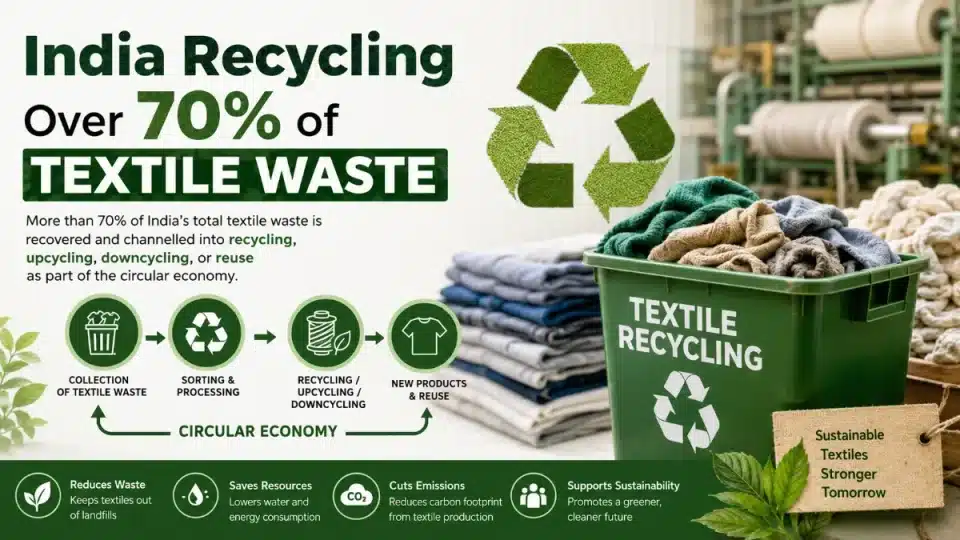
India now recovers more than 70% of its textile waste, with recycling, reuse and upcycling supporting a robust circular economy. The sustainable ecosystem processes 7.8 million tonnes of textile waste annually, generates millions of livelihoods, and strengthens India’s position as a global leader in sustainable textile manufacturing.
Key Highlights
- India recovers over 70% of its annual textile waste through recycling, reuse and upcycling.
- Nearly 95% of pre-consumer textile waste is collected and reintegrated into production.
- The circular textile ecosystem supports around 40–45 lakh livelihoods across the country.
- Textile sustainability is enhancing India’s global competitiveness and export potential.
New Delhi, July 13: India has emerged as a global leader in textile circularity, with more than 70% of its textile waste being recovered through recycling, upcycling, downcycling and reuse, according to a government factsheet. The initiative reflects the country’s growing commitment to a circular economy, where materials remain in productive use for longer, reducing waste, conserving natural resources and lowering carbon emissions.
Every year, around 7.8 million tonnes of textile waste are managed across India, with over 90% originating from domestic pre-consumer factory scrap and post-consumer textile waste. Recovery is particularly efficient during the manufacturing stage, where nearly 95% of pre-consumer textile waste is collected and reused through well-established value-chain networks, significantly reducing the industry’s environmental footprint.
The Indian spinning industry demonstrates one of the strongest examples of closed-loop manufacturing, with almost all spinning waste being reintegrated into production. In addition, around 55% of post-consumer textile waste is diverted from landfills through extensive collection, sorting and recycling systems, helping conserve water, energy and raw materials while promoting sustainable production practices.
India’s textile recycling ecosystem also plays a crucial socio-economic role by supporting nearly 40 to 45 lakh livelihoods, particularly for women from marginalised communities engaged in waste collection, sorting, processing and redistribution. The government’s emphasis on circular production is also helping India’s traditional textile craftsmanship gain wider international recognition as global buyers increasingly demand environmentally responsible and sustainable products.
Several successful recycling models illustrate this transformation. The Municipal Textile Recovery Facility in Belapur, Navi Mumbai, India’s first dedicated municipal textile recovery centre, has processed over 41,000 textile items, developed 400+ upcycled products, and reached more than 1.14 lakh families while empowering women artisans. Panipat has become India’s leading textile recycling hub, processing 3,500–5,250 tonnes of textile waste daily, while Katran Market in Delhi’s Mongolpuri efficiently connects informal waste collection with organised recycling clusters through systematic sorting and segregation.
The textile and apparel sector remains one of the largest contributors to India’s manufacturing economy, accounting for around 2% of GDP and nearly 11% of manufacturing Gross Value Added (GVA). India is also the world’s sixth-largest exporter of textiles and apparel, with a 4% share in global exports, while providing direct employment to more than 45 million people. As global markets increasingly prioritise sustainability, India’s continued investments in organic fibres, circular production, recycling technologies, eco-labelling and responsible sourcing are expected to strengthen the sector’s long-term competitiveness and export growth.
Conclusion
India’s growing textile recycling ecosystem demonstrates how sustainability, circular economy practices and innovation can simultaneously drive environmental protection, employment generation and global competitiveness.
