

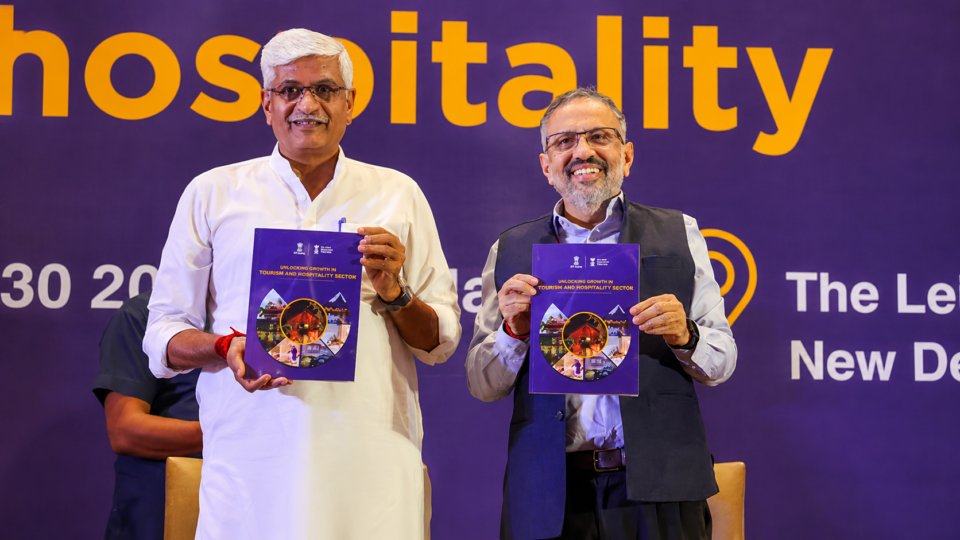
NITI Aayog, in collaboration with the Ministry of Tourism, has launched a comprehensive roadmap to improve the ease of doing business in India’s tourism and hospitality sector. The report recommends simplifying regulations, reducing compliance burdens, attracting investments, strengthening tourism infrastructure, expanding accommodation capacity and promoting sustainable tourism, in line with the vision of Viksit Bharat 2047.
Key Highlights
- NITI Aayog and the Ministry of Tourism launched a roadmap to strengthen India’s tourism and hospitality sector.
- The report recommends simpler regulations, faster approvals and improved ease of doing business.
- Focus areas include tourism infrastructure, homestays, accommodation capacity, entrepreneurship and private investment.
- The roadmap aligns with the Viksit Bharat 2047 vision to create sustainable and globally competitive tourism destinations.
India has taken another significant step towards strengthening its tourism economy with NITI Aayog, in partnership with the Ministry of Tourism, unveiling a comprehensive roadmap designed to make the country’s tourism and hospitality sector more investment-friendly, competitive and sustainable.
The report, titled ‘Unlocking Growth in Tourism and Hospitality Sector’, was launched during a national workshop in New Delhi attended by Union Tourism and Culture Minister Gajendra Singh Shekhawat, NITI Aayog Member Rajiv Gauba, Tourism Secretary Bhuvnesh Kumar, senior government officials and representatives from the tourism and hospitality industry.
The report provides an extensive review of the regulatory framework governing hotels, homestays, accommodation providers, food and beverage establishments, tour operators, tourism infrastructure projects and visa-related services. It identifies several challenges, including lengthy approval procedures, multiple compliance requirements, limited accommodation capacity and lack of coordination among departments, which often delay investments and project implementation.
To address these issues, the roadmap recommends streamlining approval processes, reducing regulatory burdens, improving inter-departmental coordination and creating a more business-friendly environment. It also highlights the importance of expanding accommodation capacity, strengthening India’s homestay ecosystem, encouraging tourism entrepreneurship and accelerating tourism infrastructure development to meet growing domestic and international travel demand.
Speaking at the workshop, Gajendra Singh Shekhawat described tourism as a powerful engine of economic growth, emphasizing that a supportive policy environment is essential to attract investment, improve visitor experiences and create employment opportunities across the country.
Rajiv Gauba highlighted that the tourism and hospitality sector plays a crucial role in employment generation, entrepreneurship and regional development. He noted that tourism investments depend heavily on predictable regulations, timely approvals and lower compliance costs, making reforms vital for sustained sectoral growth.
The workshop brought together officials from Central Ministries, State Governments, industry associations, online travel platforms, hospitality companies, academic institutions and knowledge partners. Discussions focused on tourism investment reforms, accommodation and entrepreneurship, environmental sustainability, regulatory approvals and visa facilitation, with the objective of creating a coordinated reform agenda across the country.
Aligned with the Viksit Bharat 2047 vision, the roadmap seeks to position India as a globally competitive, sustainable and inclusive tourism destination. By improving the ease of doing business and encouraging greater private sector participation, the recommendations are expected to accelerate investments, generate employment and contribute significantly to India’s long-term economic growth.
Conclusion
The NITI Aayog tourism roadmap marks an important policy initiative aimed at transforming India’s tourism and hospitality sector through simplified regulations, investment-friendly reforms and sustainable development. If implemented effectively, the recommendations can significantly enhance India’s global tourism competitiveness, create new employment opportunities and support the country’s vision of becoming a developed nation by 2047.
