

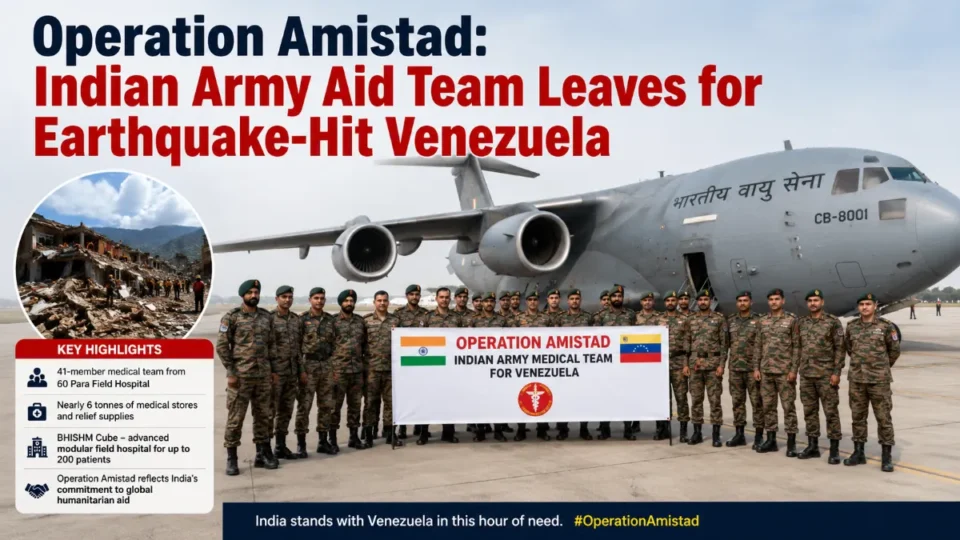
India has launched Operation Amistad by deploying a 41-member Indian Army medical team, six tonnes of humanitarian aid, and the advanced BHISHM Cube field hospital to earthquake-hit Venezuela. The mission highlights India’s commitment to global humanitarian assistance and disaster relief by providing emergency medical care and life-saving support to earthquake victims. This initiative not only addresses immediate medical needs but also reinforces international solidarity and cooperation in times of crisis, showcasing India’s capabilities in global health initiatives.
Key Highlights
- India launches Operation Amistad to assist earthquake-hit Venezuela.
- 41-member Indian Army medical contingent departs with nine medical officers.
- Nearly six tonnes of medical supplies sent along with humanitarian relief.
- BHISHM Cube modular field hospital deployed to provide advanced emergency healthcare.
India has once again demonstrated its commitment to global humanitarian assistance by launching Operation Amistad, a relief mission aimed at supporting earthquake-hit Venezuela. As the world witnesses a rise in natural disasters, India’s proactive response through this operation serves as a vital example of international cooperation. The Indian Army has dispatched a 41-member specialised medical contingent from the 60 Para Field Hospital to provide emergency healthcare services to those affected by the devastating earthquake. This contingent is composed of experts who bring a wealth of experience and specialized skills to tackle the complex medical issues arising from such disasters.
The successful execution of Operation Amistad serves as a testament to India’s commitment to humanitarian assistance. It showcases not only the capabilities of the Indian Armed Forces in disaster relief but also the importance of global solidarity in times of crisis. As the nation continues to play a pivotal role in international humanitarian efforts, the lessons learned from this operation will undoubtedly inform future responses, enhancing preparedness and coordination in global disaster management.
The medical team departed from Hindon Air Force Station aboard two Indian Air Force C-17 Globemaster aircraft. The contingent includes nine experienced medical officers trained in emergency medicine, trauma management, life-saving surgeries and disaster response. This comprehensive training ensures that they are well-prepared to face the rigors of providing medical care in challenging environments. Their mission is to establish rapid medical support in the affected areas and assist local authorities in treating injured survivors, thereby alleviating the burden on local healthcare systems already stressed by the crisis.
Along with the medical personnel, nearly six tonnes of medical stores and humanitarian relief supplies, provided by the Ministry of External Affairs, are being transported to Venezuela. This aid encompasses not only essential medicines but also emergency medical equipment and supplies required for disaster response. The careful selection of supplies reflects the priority placed on meeting the immediate health needs of the affected population. Such comprehensive aid packages are essential for ensuring that healthcare workers on the ground are fully equipped to handle the influx of patients, which typically follows after major disasters.
One of the most significant aspects of Operation Amistad is the deployment of the BHISHM Cube (Bharat Health Initiative for Sahyog, Hita & Maitri) under India’s Aarogya Maitri Project. This indigenous modular medical facility can be rapidly assembled into a fully functional field hospital capable of treating up to 200 patients. Equipped with ventilators, oxygen systems, diagnostic devices, surgical instruments and intensive care facilities, the BHISHM Cube enables swift and effective medical assistance during humanitarian emergencies. Its design is particularly advantageous in disaster scenarios where quick deployment can significantly impact survival rates and recovery times.
As the distance between India and Venezuela is around 14,300 kilometres, the aircraft will make scheduled refuelling stops at friendly nations during the journey. These planned stops not only help ensure the aircraft’s safe arrival but also symbolize the collaborative spirit of nations working together during humanitarian crises. The operation reflects India’s growing capability to respond quickly to international disasters and reinforces its image as a reliable humanitarian partner. It underscores the importance of logistics and international cooperation in modern disaster relief efforts.
Operation Amistad is another example of India’s expanding role in global disaster relief. By combining advanced medical infrastructure, trained military personnel, and humanitarian assistance, India continues to strengthen international partnerships while extending timely support to countries facing natural disasters. This operation not only represents a significant logistical feat but also emphasizes India’s dedication to humanitarian principles and its readiness to assist those in need, reinforcing the belief that together, nations can overcome the challenges posed by disasters.
