

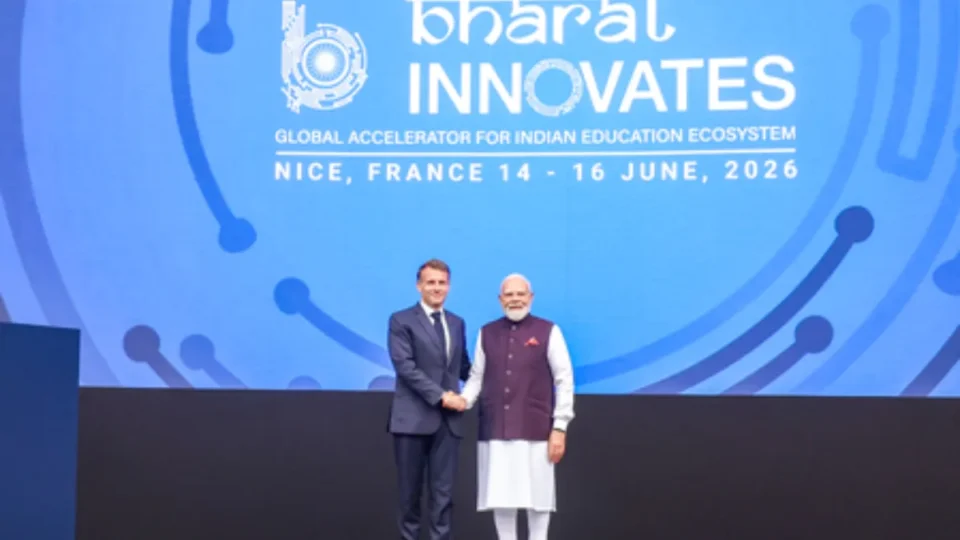
India and France have adopted the India-France Innovation Roadmap 2030 to strengthen cooperation in artificial intelligence, critical technologies, research, innovation and academic mobility. The roadmap aligns India’s Viksit Bharat 2047 vision with France 2030, creating new opportunities for investment, trusted technology ecosystems and joint innovation initiatives.
Key Highlights Box
✅ India and France adopt the India-France Innovation Roadmap 2030.
✅ Partnership aligns Viksit Bharat 2047 with France 2030 vision.
✅ Trusted Artificial Intelligence identified as a key pillar of cooperation.
✅ Focus on critical and emerging technologies, innovation and research.
✅ Both nations to strengthen AI governance and child safety online.
✅ France aims to welcome 30,000 Indian students by 2030.
✅ Increased collaboration planned between universities, researchers and SMEs.
New Delhi, June 15: India and France have unveiled an ambitious India-France Innovation Roadmap 2030 aimed at deepening cooperation in artificial intelligence, emerging technologies, research, innovation and academic partnerships, reinforcing the strategic relationship between the two countries.
The roadmap aligns India’s vision of Viksit Bharat 2047 with France’s France 2030 strategy, creating a framework for long-term collaboration in technology-driven growth, industrial competitiveness and sustainable development.
According to an official statement, both countries recognize innovation as a key driver of economic resilience, technological sovereignty, strategic autonomy and sustainable prosperity.
The roadmap is designed to accelerate co-development in critical and emerging technologies, strengthen trusted technology ecosystems and create new investment opportunities in disruptive innovation sectors.
India and France believe that a stronger innovation partnership will unlock the full potential of their scientific, technological and entrepreneurial ecosystems while contributing to solutions for major global challenges.
A major focus of the roadmap is the development of Trusted Artificial Intelligence (AI), which has been identified as a central pillar of bilateral cooperation.
The initiative builds on the India-France Declaration on Artificial Intelligence signed in February 2025 and the AI-focused summits hosted by France and India in 2025 and 2026 respectively.
Both countries have agreed to promote safe, secure and trustworthy AI systems that respect democratic values, protect human rights and support sustainable development goals.
The partnership also seeks to address emerging challenges related to misinformation, algorithmic bias and responsible deployment of frontier and generative AI technologies.
To strengthen governance frameworks, India and France will encourage collaboration among regulators, standards-setting organizations and technical experts to develop interoperable and risk-based approaches to AI regulation.
A significant aspect of the agreement is the commitment to enhance cooperation on child safety in the digital environment, recognizing the growing risks posed by AI-enabled services to children and vulnerable groups.
The two countries also emphasized the importance of privacy-preserving data-sharing frameworks that can support innovation while safeguarding individual rights and data protection standards.
Education, research and talent mobility form another key pillar of the Innovation Roadmap 2030.
Both sides acknowledged that investments in STEM education, research partnerships, innovation ecosystems and institutional collaboration will play a vital role in preparing future generations for global challenges.
India and France reaffirmed their commitment to strengthening people-to-people ties through expanded educational exchanges and academic collaboration.
In this context, both countries welcomed France’s goal of hosting 30,000 Indian students by 2030, a target expected to significantly strengthen educational and cultural linkages.
Several academic institutions from both nations have already agreed to collaborate through student exchange programmes, joint research projects and innovation-focused partnerships.
The roadmap also recognizes the critical role of small and medium enterprises (SMEs) in driving innovation, job creation and inclusive economic growth.
Both governments have expressed interest in expanding interactions between SME ecosystems to encourage technology transfer, entrepreneurship and business collaboration.
The agreement reflects the growing strategic convergence between India and France in areas such as digital transformation, advanced technologies, industrial innovation and global technology governance.
The India-France Innovation Roadmap 2030 marks a significant step in strengthening one of the world’s most dynamic technology and innovation partnerships. By focusing on trusted AI, emerging technologies, research collaboration, talent mobility and innovation-driven growth, both nations are laying the foundation for deeper economic cooperation and long-term technological leadership while advancing the shared visions of Viksit Bharat 2047 and France 2030.
FAQ Section
What is the India-France Innovation Roadmap 2030?
It is a strategic framework designed to enhance cooperation between India and France in innovation, artificial intelligence, research, technology and education.
What are the key areas of cooperation under the roadmap?
The roadmap focuses on AI, emerging technologies, research partnerships, academic mobility, technology ecosystems and SME collaboration.
Why is Trusted AI important in the partnership?
Trusted AI aims to ensure that artificial intelligence systems are safe, secure, transparent, ethical and aligned with democratic values and human rights.
How many Indian students does France aim to host by 2030?
France has set a target of welcoming 30,000 Indian students by 2030.
How does the roadmap support Viksit Bharat 2047?
The roadmap promotes innovation, technology development, research collaboration and talent growth, supporting India’s long-term economic and technological development goals.
Related posts :
 Viksit Bharat : G RAM G Act, 2025 — Quwstions & Answers
 OpenAI Plans Major ChatGPT Overhaul to Become a ‘Superapp’, Expands Focus on Enterprise Growth
 AI can help India leapfrog without building its own models : Rubrik executive
 Apple unveils AI-powered Maps, Wallet and Find My in 2027 software updates
 PM Narendra Modi Becomes India’s Longest-Serving Elected Prime Minister, Completes 4,399 Days in Office
