

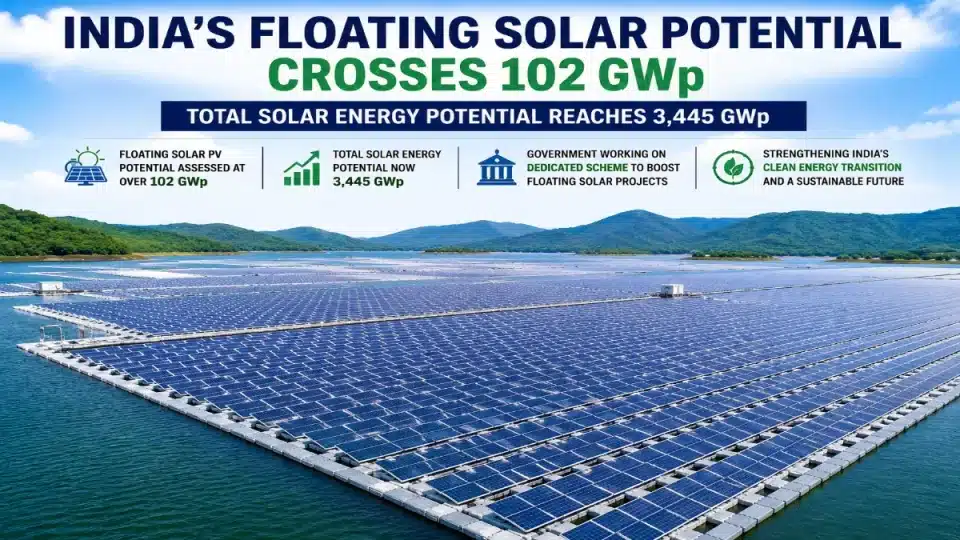
India’s floating solar photovoltaic (PV) potential has been assessed at more than 102 GWp, pushing the country’s total estimated solar energy potential to 3,445 GWp, according to Union Minister Pralhad Joshi. The government is preparing a dedicated scheme to boost floating solar projects, reinforcing India’s clean energy transition and renewable energy expansion goals.
Key Highlights
- India’s floating solar PV potential assessed at 102 GWp+
- Total solar energy potential reaches 3,445 GWp
- Government working on dedicated floating solar promotion scheme
- Online portal launched for Small Hydro Power Development Scheme
- Solar capacity increased from 2.8 GW in 2014 to 155 GW
- Non-fossil fuel capacity surged from 81 GW to 288 GW
- India emerges as a global renewable energy manufacturing hub
- NISE and Military Engineering Services sign MoU for solar adoption
India has achieved a significant milestone in its renewable energy journey with the assessment of more than 102 GWp of floating solar photovoltaic (PV) potential, taking the country’s total estimated solar power potential to 3,445 GWp.
Announcing the development, Union Minister for New and Renewable Energy Pralhad Joshi said the government is actively working on a dedicated scheme aimed at accelerating the deployment of floating solar projects across the country.
The minister highlighted that reservoirs, lakes and other water bodies are becoming valuable assets for clean energy generation. Floating solar projects not only help generate renewable energy but also optimize the use of available water resources without requiring large tracts of land.
According to Joshi, these initiatives demonstrate the government’s commitment to sustainable resource utilization while supporting India’s ambitious clean energy transition goals.
The minister also launched the online portal for the Small Hydro Power Development Scheme, describing it as a major policy intervention in the sector since 2017. The portal is expected to improve transparency, efficiency and ease of implementation for small hydro projects nationwide.
Joshi emphasized that flagship initiatives such as PM Surya Ghar: Muft Bijli Yojana and PM-KUSUM are increasing citizen participation in renewable energy adoption and helping accelerate India’s transition towards cleaner sources of power.
He credited Prime Minister Narendra Modi’s leadership for driving India’s transformation into a global clean energy leader over the past twelve years.
The minister noted that India’s non-fossil fuel power capacity has expanded from 81 GW in 2014 to 288 GW, while installed solar capacity has risen dramatically from 2.8 GW to 155 GW during the same period.
India’s renewable energy manufacturing ecosystem has also strengthened significantly. Domestic solar module manufacturing capacity has reached 192 GW, while solar cell manufacturing capacity has expanded to 30 GW, reflecting the country’s growing self-reliance in clean energy technologies.
Highlighting India’s global standing, Joshi said the nation has transformed from a power-deficit economy into a power-surplus country and has gained international recognition for meeting ambitious climate and renewable energy targets.
On the occasion, the National Institute of Solar Energy (NISE) and the Military Engineering Services (MES) signed a Memorandum of Understanding to enhance solar energy adoption across defence establishments. Under the agreement, NISE will provide technical assistance for planning, implementation and monitoring of renewable energy projects.
The minister also released the book “Green Energy and Sustainable Development” authored by Dr. Mohammad Rihan and praised NISE for its contributions to research, innovation and technical support in advancing India’s renewable energy ambitions.
Joshi expressed confidence that the initiatives launched would contribute significantly towards building a self-reliant and developed India powered by clean and sustainable energy.
