

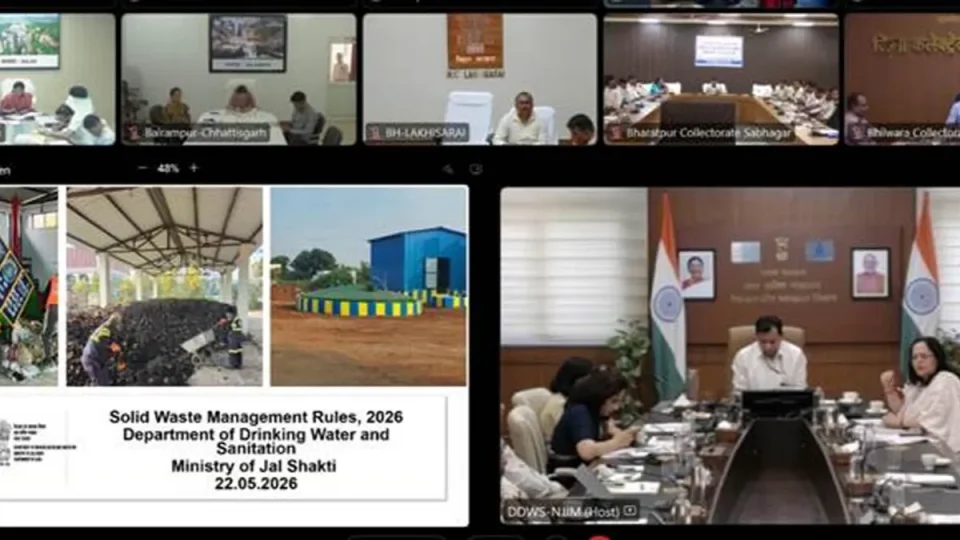
New Delhi, May 27 The Department of Drinking Water and Sanitation (DDWS) under the Ministry of Jal Shakti on Wednesday held a nationwide review meeting with over 759 Deputy Commissioners, District Magistrates and District Collectors to assess the implementation of Jal Jeevan Mission (JJM) 2.0 and enforcement of the Solid Waste Management (SWM) Rules, 2026 in rural areas.
The virtual meeting was chaired by DDWS Secretary Ashok K.K. Meena and attended by senior officials, including Kamal Kishore Soan, Additional Secretary and Mission Director, National Jal Jeevan Mission (NJJM), and Aishvarya Singh, Joint Secretary and Mission Director, SBM(G).
Addressing the meeting, Ashok K.K. Meena said both Jal Jeevan Mission and Swachh Bharat Mission-Grameen (SBM-G) have entered a phase where the focus must shift from infrastructure creation to reliable service delivery, sustainability and community ownership. Referring to the Union Cabinet’s approval extending JJM till December 2028, he said JJM 2.0 marks a transition towards sustained drinking water services in rural India.
He urged district officials to actively use the District Water and Sanitation Mission (DWSM) dashboard to monitor drinking water supply, water quality, grievance redressal and operation and maintenance of schemes.
Highlighting sanitation and waste management as critical to public health and water sustainability, Meena directed officials to ensure segregation, collection and scientific disposal of waste in line with the SWM Rules, 2026, noting that their implementation is also being reviewed in an ongoing Supreme Court PIL.
Kamal Kishore Soan stressed the crucial role of District Collectors in implementing JJM and SBM(G), noting that JJM currently covers around 5.91 lakh villages, 19.41 crore rural households and nearly 96 crore people. He said India is on track to achieve universal access to safe drinking water by December 2028, ahead of the global 2030 target, and called for saturation of Tribal and PVTG habitations by 2027 under PM JANMAN and DA-JUGA.
The meeting also featured presentations on JJM 2.0 and SBM-G Phase II, highlighting reforms focused on sustainable service delivery, community ownership, water quality monitoring, digital governance and financial sustainability. Officials highlighted the Sujalam Bharat digital platform, GIS-based asset tracking and stricter commissioning and handover protocols for rural water schemes.
Presenting the roadmap for SWM Rules, 2026, Aishvarya Singh said District Collectors have been designated as the single-point enforcement authority for waste management implementation. Districts were directed to identify all legacy waste sites by October 31 and ensure remediation under prescribed timelines. She also reiterated that only twin-pit toilets should be sanctioned under household sanitation schemes during the current year.
During the interaction, District Collectors raised concerns related to scheme handovers, O&M planning, village-level operators and user charge collection. Responding to the queries, Soan emphasised the need for advance O&M planning, comprehensive asset mapping through Sujalam Bharat and stronger community ownership to ensure long-term sustainability of rural water supply systems.
Concluding the meeting, Soan said the interaction marked the beginning of a regular review process for JJM and SBM(G) and stressed that district leadership will be central to improving drinking water and sanitation services across rural India.
