

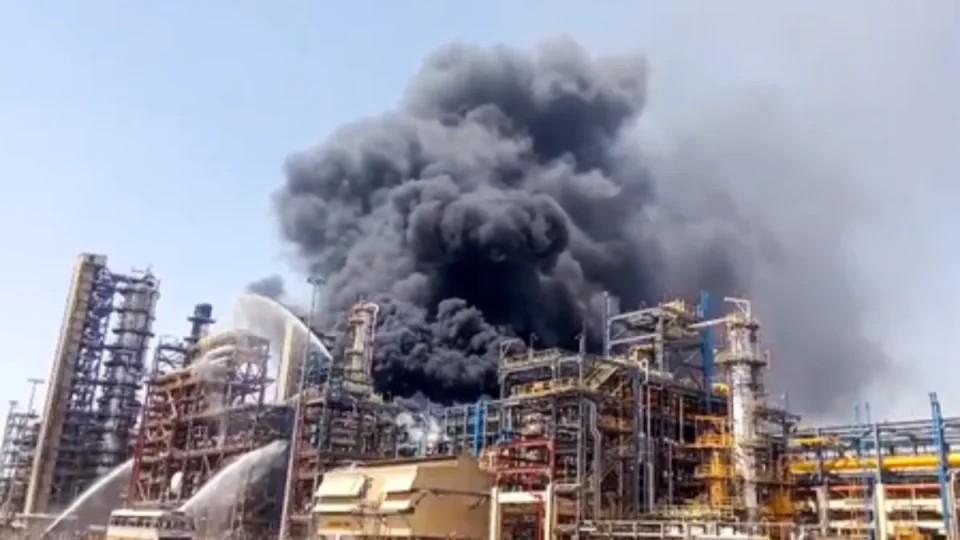
New Delhi, April 27: Hindustan Petroleum Corporation Limited (HPCL) has identified a pressure gauge leak as the likely cause of the fire at its joint venture refinery in Rajasthan, with restoration work expected to be completed within three to four weeks. The company anticipates restarting the crude distillation unit (CDU) in the second half of May 2026.
The incident occurred on April 20 at HPCL Rajasthan Refinery Limited (HRRL), a day before its scheduled inauguration by Prime Minister Narendra Modi. The fire was confined to the heat exchanger stack within the crude distillation unit, impacting six exchangers and related equipment.
According to HPCL’s stock exchange filing, the blaze was likely triggered by a hydrocarbon leak from a pressure gauge tapping point on the vacuum residue exchanger inlet line. Other units at the refinery remain in advanced stages of commissioning and are progressing as planned.
Trial production of key fuels—including LPG, petrol, diesel, and naphtha—is expected to begin within May, followed by stabilisation and full commissioning. The refinery’s inauguration has been postponed, with a revised date yet to be announced.
The Ministry of Petroleum and Natural Gas has launched a separate probe into the incident, led by former MRPL Managing Director M. Venkatesh.
The ₹79,450-crore refinery-cum-petrochemical complex, located in Rajasthan’s Balotra district, is designed as a 9 million tonnes per annum facility with a strong petrochemical focus. With a Nelson Complexity Index of 17 and petrochemical yields exceeding 26%, the project ranks among India’s most advanced refining assets.
A joint venture between HPCL (74%) and the Rajasthan government (26%), the refinery is expected to enhance domestic production of fuels and petrochemicals such as polypropylene, polyethylene, benzene, and butadiene, supporting India’s push to reduce import dependence and expand value-added output.
Related posts :
 #WorldBloodDonorDay : REC Limited Organizes Blood Donation Camp
 Yoga for One Earth, One Health : NTPC Bongaigaon organises workshop under its Ahwahan Policy
 NHPC signs MoU with NSDF and Sports Authority of India to empower young talented Weightlifters
 NLC INDIA LIMITED’S CORPORATE ENVIRONMENT CELL HONOURED WITH GREENTECH ENVIRONMENT AWARD 2025
 ONGC gas leakage: Hardeep Puri reviews ‘well control’ activities
