

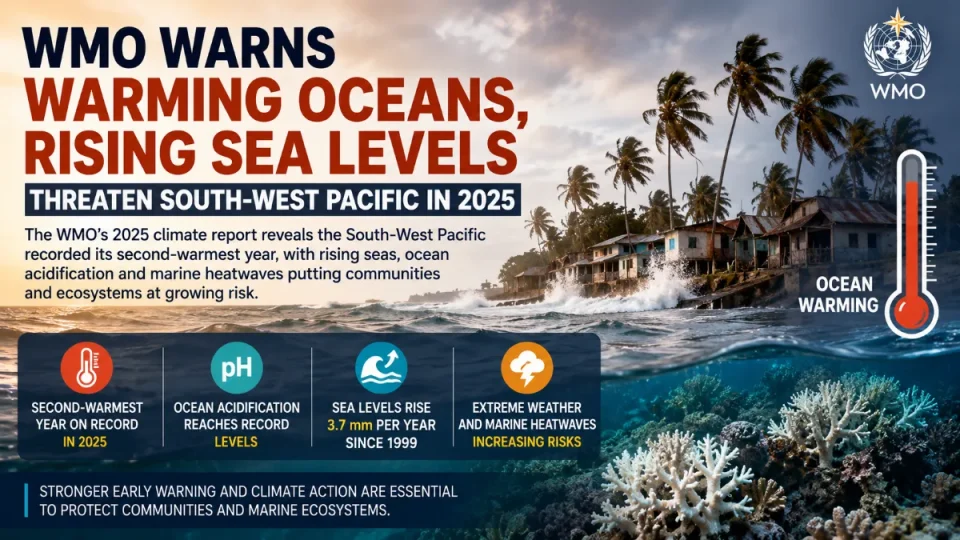
The World Meteorological Organization (WMO) has warned that the South-West Pacific experienced its second-warmest year on record in 2025. Rising sea levels, worsening ocean acidification and increasingly intense marine heatwaves are placing coastal communities, island nations, marine ecosystems and regional economies under growing climate pressure.
Key Highlights
- South-West Pacific recorded its second-warmest year in 2025.
- Ocean acidification reached record levels across most of the region.
- Sea levels have risen by an average of 3.7 mm annually since 1999.
- Marine heatwaves and extreme weather are increasing climate-related risks.
The World Meteorological Organization (WMO) has raised fresh concerns over the accelerating impact of climate change after the South-West Pacific recorded its second-warmest year on record in 2025. Released in Singapore, the latest climate report highlights how rising temperatures are reshaping marine ecosystems and increasing risks for millions of people living across the region.
According to the report, the annual mean surface air temperature across land and ocean was 0.37°C above the 1991–2020 average. Scientists say continued ocean warming is driving more frequent, longer-lasting and more intense marine heatwaves, which are becoming one of the biggest threats to ocean health.
These marine heatwaves are causing coral bleaching, fish mortality, harmful algal blooms, kelp forest decline and disruptions to aquaculture, putting biodiversity, fisheries and coastal livelihoods under increasing stress. The report also found exceptionally high ocean heat content in several parts of the Pacific and waters surrounding Australia and Indonesia.
Another major concern is the steady rise in sea levels, which increased by an average of 3.7 millimetres per year between 1999 and 2025. At the same time, the region experienced record-low ocean pH levels, reflecting worsening ocean acidification caused by the oceans absorbing more carbon dioxide from the atmosphere.
The report also highlighted the growing impact of extreme weather events, including Cyclone Senyar, which affected more than 10 million people in Indonesia and Malaysia and claimed over 1,200 lives. The WMO stressed that stronger early warning systems, climate adaptation and global efforts to reduce greenhouse gas emissions are essential to protect vulnerable communities and safeguard the region’s future.
Conclusion
The WMO’s latest findings underline the urgent need for stronger climate action as warming oceans, rising seas and extreme weather continue to threaten the South-West Pacific and its people.
