

India to invest US 150 Bln for Renewable Power
Six Working Groups hold extensive deliberations
By TN Ashok / Energy Editor
New Delhi, Sept 23: India’s Power Minister Piyush ‘Goyal today announced India would be investing US $ 150 billion in the next seven years to pursue its ambitious plan for deployment of 175 GW Renewable Power capacities by 2022, including 100 GW of solar and 60 GW of Wind. He also stressed on Governments plan to provide 24×7 power across India by 2019 by creating cost effective infrastructure which was sustainable and inclusive of clean energy solutions.
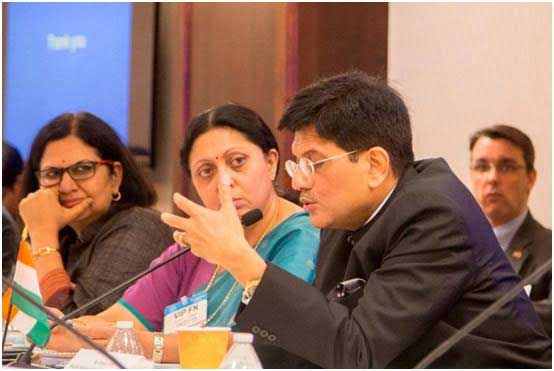
He was addressing the India-US Ministerial Energy Dialogue at Washington DC where he led the Indian delegation as the minister for power and renewable energy and coal while the US side was led by Dr Ernest Moniz, the US Secretary of Energy.
During the Dialogue, the Minister reviewed the progress made by the six Working Groups of the Energy Dialogue and identified new areas for cooperation. They also reviewed various energy related issues agreed in the India – US Joint Statement during President Obama’s visit to India in January 2015.
Goyal elaborated on the Government’s objective of construction of 100 smart cities that provided in its blue print adequate provisions for power generation, usage of renewables and energy efficiency technologies, comprehensive waste management programme; usage of waste to energy technologies etc.
Goyal pointed out that India-US collaboration in the energy sector offered great potential, in view of India’s enormous energy needs and the US’s resources, capabilities and technology. He welcomed US based companies to invest in the Indian energy sector and invited them to also participate in India’s unconventional hydrocarbons sector, especially in the field of exploration and exploitation of alternate energy sources such as shale oil, shale gas and gas hydrates.
During the Dialogue, presentations were made on progress made under various joint research programme like Partnership to Advance Clean Energy – Research (PACE – R), including in the field of solar energy, energy efficient buildings and biofuels. Substantial headway has been made for the development of new technologies for distributed power generation through solar thermal route and development of new tools for improved building energy efficiency codes. It was also agreed to explore addition of smart grids and energy storage for grid application as the fourth stream under PACE – R.
Presentations were also made on various aspects of integration of clean energy sources into existing energy infrastructure in India, as well as mechanisms for promoting financing for clean energy and cleaner fossil energy sources. Avenues for advancing off-grid clean energy access was also discussed in depth during the Dialogue.
Bearing in mind the commitment of both countries to climate change, the focus of the meeting revolved on various dimensions of clean energy in order to ensure that people have access to adequate and affordable energy for better quality of life and sustainable livelihood.
While capturing the activities of the Energy Dialogue in the last 10 years, the two Minister’s recognized that this was an appropriate forum for India and the US to identify various aspects of technical assistance in Energy sector as well as launch of pilot projects which can be scaled up at a later stage. The Indian delegation appreciated the activities of DOE, USAID and USTDA in various aspects of the energy sector in India especially for technical assistance in research, data collection, and development of various regulations as well as for improving energy efficiency appliances.
The need to develop a robust energy data management system to develop better simulation of the energy scenario in India in the future was also recognized.
Prior to the Ministerial Dialogue, all the six Working Groups under the Energy Dialogue held extensive deliberations on September 16-18, 2015. The six Working Groups included Working Groups on a) Coal, b) New Technology and Renewable Energy, c) Petroleum and Natural Gas, d) Power and Energy Efficiency, e) Sustainable Development and f) Partnership to Advance Clean Energy – Research (PACE -R).
The Working Group on Coal identified some areas of coal mining where both countries could collaborate including on Dry Coal Beneficiation; Planning of Large capacity opencast mines; Rehabilitation and reclamation of mined out areas; Pre combustion moisture removal of raw lignite and Mining of deep seated lignite deposits.
It was recognized that India had proven reserves of shale gas and US had well developed expertize for Shale gas extraction. Collaboration in the area of fracking of shale gas, especially water less fracking in India were identified as areas of future cooperation under the Energy Dialogue.
Discussions were also held in the working groups on financing of clean energy technology as well as on innovative financing for renewable energy microfinance and micro enterprises.
Discussions were held on various aspects, including advantages and challenges of greening the grid, i.e., to integrate large scale renewable energy sources into the electricity grid. Joint work under the 21st Century Power Partnership laid the foundation for the “Greening the Grid” programme. In the power and energy efficiency working group, in addition to scaling up of the existing collaboration, it was decided to work in the future on energy efficiency in the following areas, namely a) Low Waste Heat Utilization; b) Data Centre energy efficiency and c) Space cooling.
The working groups also explored various options of translating joint research being undertaken under this mechanism to effective deployment by integrating research with deployment (“PACE-R” with “PACE-D”). It was also agreed to significantly scale up Promoting Energy Access through Clean Energy (PEACE), (India – US off-grid clean energy partnership), and develop innovative mechanisms to encourage participation of private sector investments for off-grid solutions.
While recognising that coal based power plants would continue to be the mainstay of India’s electricity generation source in the coming decades, The Indian delegation urged the US to share technology related to supercritical coal plants as well as share best practices and tools to improve efficiency and carbon footprint of existing power plants. It was agreed to expeditiously conclude the following MoUs a) between National Energy Technology Laboratory (NETL) of the US and NTPC of India to improve power plant efficiency; b) to enhance cooperation on energy security, clean energy and climate change; as well as c) on Gas Hydrates.
This Dialogue is also an affirmation of the fact that both countries have a strong commitment to collaborate in the energy sector and promote greater technological innovation, scientific collaboration, trade, research and development, deploying environment-friendly technologies and products, and promote sound regulatory frameworks to deliver energy solutions for sustainable growth.
