

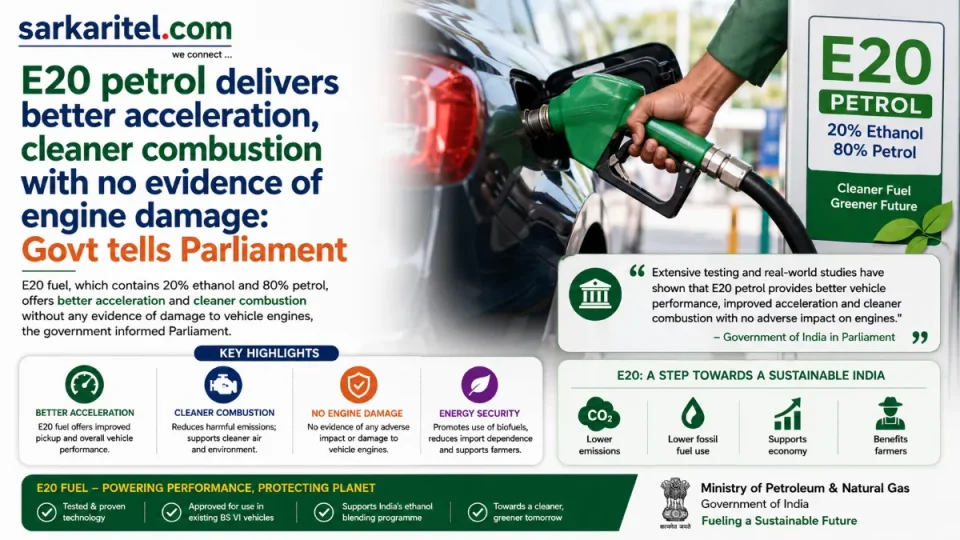
The Government of India has informed Parliament that E20 petrol delivers better acceleration, improved ride quality and nearly 30% lower carbon emissions than E10 fuel. Studies by ARAI, SIAM, Indian Oil and automobile manufacturers found no evidence of ethanol-induced engine damage or reduced vehicle life, including in legacy vehicles.
Key Highlights
- E20 petrol offers better acceleration and improved ride quality than E10 fuel.
- Carbon emissions are reduced by nearly 30%, improving urban air quality.
- Government says studies found no evidence of engine corrosion or abnormal wear due to E20.
- Real-world data from millions of vehicles supports E20’s safety and durability.
New Delhi, July 27: The Government of India on Monday told the Rajya Sabha that E20 petrol provides better acceleration, smoother ride quality and nearly 30% lower carbon emissions compared with E10 petrol, while extensive scientific studies and real-world vehicle data have found no evidence of engine damage, corrosion or reduced vehicle life. Responding to a question in Parliament, Minister of State for Petroleum and Natural Gas Suresh Gopi said the higher ethanol blend enables cleaner and more complete combustion, contributing to near-zero particulate matter emissions and improved urban air quality.
According to the Ministry of Petroleum and Natural Gas, E20 fuel underwent comprehensive evaluation before its nationwide rollout. The assessment included laboratory studies and field trials conducted by the Automotive Research Association of India (ARAI), Society of Indian Automobile Manufacturers (SIAM), Indian Oil Corporation (IOC), Indian Institute of Petroleum (IIP) and leading automobile manufacturers. The studies examined engine durability, drivability, cold start performance, corrosion resistance, material compatibility, fuel efficiency and emissions, concluding that E20 petrol is safe for use under prescribed standards.
The government also clarified that legacy vehicles, which were not originally certified for E20 fuel, have shown no significant variation in performance or abnormal wear and tear. Supporting this claim, it cited data from a leading automobile manufacturer that serviced 2.84 crore vehicles during FY 2025-26, including nearly 1.5 crore vehicles not initially designed for E20 compatibility, without reporting any E20-related corrosion, abnormal engine wear or reduction in component life. A leading two-wheeler manufacturer reported similar findings, while another major original equipment manufacturer (OEM) monitored 1.4 crore vehicles operating on E20 fuel and found no evidence of ethanol-induced corrosion over an extended period.
The ministry added that ARAI continues to validate vehicles through rigorous international-standard testing before they reach consumers, ensuring safety and performance. The government’s findings reinforce India’s Ethanol Blended Petrol (EBP) Programme, which aims to reduce dependence on imported crude oil, lower greenhouse gas emissions, support farmers through increased ethanol production and promote cleaner, more sustainable transportation across the country.
The government’s latest statement strengthens confidence in E20 petrol, highlighting its environmental benefits, improved vehicle performance and safety. Backed by extensive testing and data from millions of vehicles, E20 is expected to play a key role in India’s clean mobility and energy security goals.
