

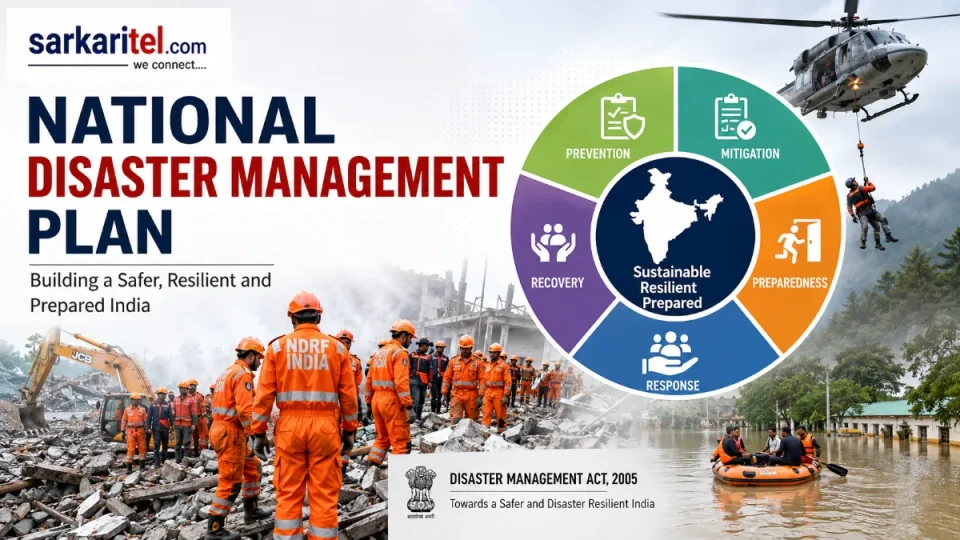
The National Disaster Management Plan (NDMP) serves as India’s comprehensive framework for disaster risk reduction by defining the roles of governments and agencies at every level. Complementing the plan, the India Disaster Resource Network (IDRN) provides a nationwide digital inventory of emergency resources to strengthen disaster preparedness and response.
Key Highlights
- National Disaster Management Plan (NDMP) was first issued in 2016 and revised in 2019 after stakeholder consultations.
- The plan aligns with the Disaster Management Act, 2005, National Policy on Disaster Management (NPDM) 2009, and international disaster risk reduction commitments.
- India Disaster Resource Network (IDRN) provides a nationwide web-based inventory of emergency equipment, skilled personnel and critical supplies.
- Minister of State in the Ministry of Home Affairs Shri Nityanand Rai shared the details in a written reply in the Rajya Sabha.
The National Disaster Management Plan (NDMP) continues to serve as India’s overarching policy framework for disaster preparedness and risk reduction. First issued in 2016 and revised in 2019 following consultations with stakeholders, the plan integrates the responsibilities of Central and State governments, district administrations, ministries, departments and other agencies to strengthen coordinated disaster management across the country. The information was shared by Minister of State in the Ministry of Home Affairs Shri Nityanand Rai in a written reply to a question in the Rajya Sabha.
The revised National Disaster Management Plan (NDMP) is designed in accordance with the Disaster Management Act, 2005 and the National Policy on Disaster Management (NPDM) 2009. It also reflects India’s commitments under international frameworks, including the Sendai Framework for Disaster Risk Reduction (DRR), the Sustainable Development Goals (SDGs) and the Conference of Parties (COP21), Paris Agreement on Climate Change, ensuring that national disaster management strategies remain aligned with global priorities.
A key feature of the National Disaster Management Plan (NDMP) is its emphasis on the Prime Minister’s Ten Point Agenda for DRR, which outlines India’s contemporary priorities for reducing disaster risks. The framework also adopts social inclusion as a cross-cutting principle while promoting the mainstreaming of disaster risk reduction across sectors, institutions and governance systems.
Supporting the implementation of disaster preparedness is the India Disaster Resource Network (IDRN), a nationwide electronic inventory that compiles information on emergency equipment, skilled human resources and critical supplies from districts, States, Union Territories and national-level line departments and agencies. The platform operates as a web-based system to facilitate efficient resource management during emergencies.
The primary objective of the India Disaster Resource Network (IDRN) is to help decision-makers quickly identify the availability of equipment and trained personnel required to respond to emergency situations. The database also enables authorities to evaluate preparedness levels for different types of disasters by mapping the location and availability of critical resources across the country.
According to the Ministry of Home Affairs, the India Disaster Resource Network (IDRN) enables States, Union Territories and other stakeholders to access resource information rapidly during disasters, supporting timely response and coordination. Details of the platform are available at https://idrn.nidm.gov.in, reinforcing the Government’s efforts to strengthen disaster resilience through technology-enabled resource management. The key takeaway is that the National Disaster Management Plan (NDMP) and India Disaster Resource Network (IDRN) together provide the policy and operational foundation for India’s disaster preparedness framework.
Why It Matters
The National Disaster Management Plan (NDMP) establishes a coordinated national framework for disaster risk reduction while the India Disaster Resource Network (IDRN) enhances emergency response by providing real-time information on critical resources. Together, they improve preparedness, coordination and resilience across all levels of government.
The Government of India’s disaster management framework combines policy planning through the National Disaster Management Plan (NDMP) with technology-driven resource coordination via the India Disaster Resource Network (IDRN). This integrated approach supports faster emergency response and strengthens disaster preparedness nationwide.
Frequently Asked Questions
What is the National Disaster Management Plan (NDMP)?
The National Disaster Management Plan (NDMP) is India’s national framework for disaster risk reduction and coordinated disaster management, first issued in 2016 and revised in 2019.
When was the National Disaster Management Plan revised?
The National Disaster Management Plan (NDMP) was revised in 2019 after consultations with stakeholders.
What is the India Disaster Resource Network (IDRN)?
The India Disaster Resource Network (IDRN) is a nationwide web-based inventory of emergency equipment, skilled human resources and critical supplies used to support disaster response.
Who provided the information on the National Disaster Management Plan?
The information was provided by Minister of State in the Ministry of Home Affairs Shri Nityanand Rai in a written reply to a question in the Rajya Sabha.
