

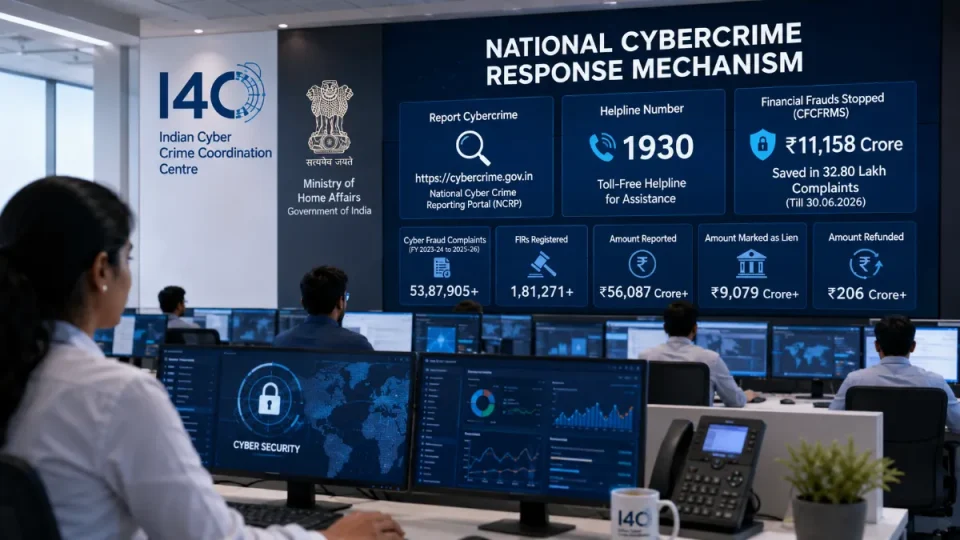
Ministry of Home Affairs has strengthened India’s national cybercrime response through the Indian Cyber Crime Coordination Centre (I4C), saving over ₹11,158 crore in financial fraud cases while expanding digital investigation, cyber forensics, interstate coordination and public grievance mechanisms across the country.
Key Highlights
- I4C has helped save more than ₹11,158 crore in over 32.80 lakh cyber financial fraud complaints till 30 June 2026.
- The National Cyber Crime Reporting Portal (NCRP) and 1930 Helpline continue to strengthen nationwide cybercrime reporting and response.
- New Money Restoration Module and Grievance Redressal Module became operational in April 2026 to speed up fund restoration and complaint resolution.
- Ministry of Home Affairs has expanded cyber forensic infrastructure, interstate coordination and capacity building through multiple national initiatives.
The Ministry of Home Affairs (MHA) has significantly strengthened India’s National Cybercrime Response Mechanism through the Indian Cyber Crime Coordination Centre (I4C), an attached office established to coordinate efforts against all forms of cybercrime. As part of this initiative, the National Cyber Crime Reporting Portal (NCRP) enables citizens to report cyber offences, with particular attention to crimes targeting women and children.
The Citizen Financial Cyber Fraud Reporting and Management System (CFCFRMS), launched under I4C in 2021, has emerged as a key platform for reporting financial cyber fraud and preventing fraudulent fund transfers. According to official data, more than ₹11,158 crore has been safeguarded across over 32.80 lakh complaints till 30 June 2026. Citizens can also seek immediate assistance through the toll-free 1930 helpline.
Official data further shows that during the financial years 2023–24 to 2025–26, the NCRP recorded more than 53.87 lakh cyber fraud complaints, leading to over 1.81 lakh FIRs. The reported fraud amount exceeded ₹56,087 crore, while more than ₹9,079 crore was marked under lien and over ₹206 crore was refunded to victims. Investigation, FIR registration, chargesheets, arrests and complaint resolution continue to be handled by the respective State and Union Territory Law Enforcement Agencies.
To improve operational efficiency, the Ministry of Home Affairs has issued a comprehensive Standard Operating Procedure for NCRP-CFCFRMS covering complaint processing, bank coordination, grievance redressal, removal of lien markings and restoration of defrauded funds. The Money Restoration Module and Grievance Redressal Module, operational since April 2026, are designed to accelerate fund recovery for victims and address grievances relating to frozen bank accounts and lien markings.
The Central Government is also enhancing real-time fraud prevention through API integration between CFCFRMS and financial institutions for immediate blocking of fraudulent transactions. Major initiatives include the Cyber Fraud Mitigation Centre (CFMC), Samanvaya Platform, Pratibimb module, Sahyog Portal, Suspect Registry, seven Joint Cyber Coordination Teams (JCCTs), regular capacity-building programmes and the National-Digital Investigation Support Centre in New Delhi and Assam. Till 30 June 2026, the New Delhi centre had supported investigations in over 14,064 cybercrime cases, while Pratibimb contributed to the arrest of more than 29,837 accused and processed over 2,33,593 cyber investigation assistance requests.
The Government has also released ₹132.93 crore under the Cyber Crime Prevention against Women and Children (CCPWC) Scheme to strengthen cyber forensic laboratories, recruit cyber consultants and train law enforcement agencies, prosecutors and judicial officers. Cyber forensic-cum-training laboratories have been commissioned in 33 States and Union Territories, while more than 24,600 personnel have received specialised training. The most significant takeaway is that India’s national cybercrime response framework is being expanded through technology, institutional coordination and enhanced forensic capabilities to improve cyber fraud prevention and victim support.
Why It Matters
The rapid growth of digital payments and online services has increased cybercrime risks across India. Strengthening I4C, cyber forensic infrastructure and coordinated response mechanisms helps protect citizens, improve fraud recovery, enhance investigations and build trust in the country’s digital ecosystem.
The initiatives undertaken by the Ministry of Home Affairs demonstrate a comprehensive approach to combating cybercrime through technology, institutional coordination, forensic support and public participation. Continued investments in cyber security infrastructure are expected to strengthen India’s ability to prevent, investigate and resolve cybercrime cases effectively.
FAQs
Q1. What is the Indian Cyber Crime Coordination Centre (I4C)?
A. I4C is an attached office of the Ministry of Home Affairs that coordinates national efforts to prevent, detect and investigate cybercrime.
Q2. What is the National Cyber Crime Reporting Portal?
A. The NCRP is the Government’s online platform for reporting all types of cybercrime, especially offences against women and children.
Q3. What is the 1930 cybercrime helpline?
A. 1930 is the national toll-free helpline for reporting financial cyber fraud and obtaining immediate assistance.
Q4. How much money has been saved through CFCFRMS?
A. According to I4C, more than ₹11,158 crore has been saved in over 32.80 lakh complaints till 30 June 2026.
