

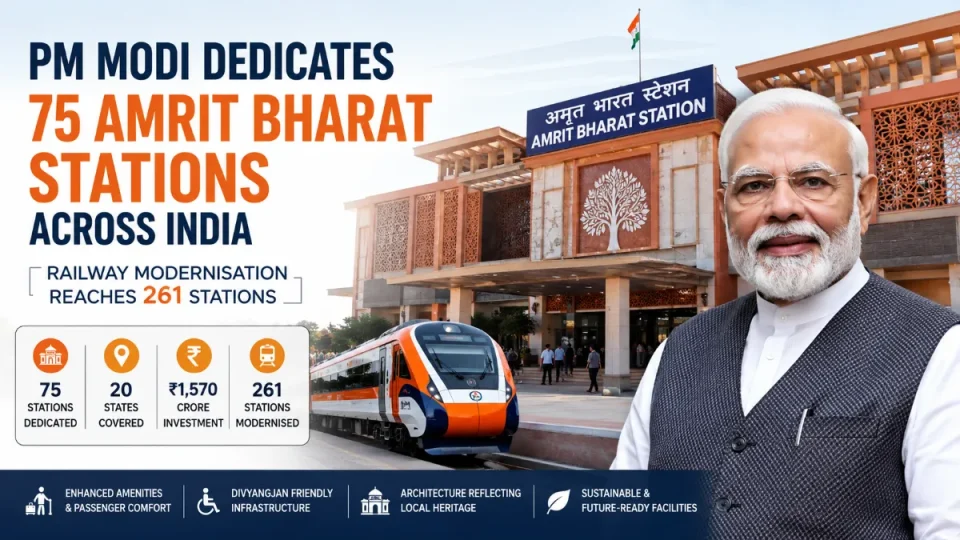
Prime Minister Narendra Modi dedicated 75 redeveloped Amrit Bharat Stations across 20 states under the Amrit Bharat Station Scheme (ABSS). With this inauguration, 261 railway stations have been modernised, while redevelopment of 1,340 stations continues nationwide to transform Indian Railways with world-class passenger amenities.
Key Highlights
Transforming Indian Railways: A New Era of Travel
- Prime Minister Narendra Modi dedicated 75 redeveloped railway stations across 20 states.
- The stations have been modernised at a cost of approximately Rs 1,570 crore.
- A total of 261 stations have now been redeveloped under the Amrit Bharat Station Scheme.
- The government plans to redevelop 1,340 railway stations across India in phases.
Prime Minister Narendra Modi on Saturday dedicated 75 redeveloped Amrit Bharat Stations to the nation under the Amrit Bharat Station Scheme (ABSS), marking another milestone in India’s railway infrastructure transformation. The newly inaugurated stations span 20 states and have been redeveloped at a combined investment of around Rs 1,570 crore.
This is the second nationwide inauguration of redeveloped stations under the flagship scheme. Earlier, on 22 May 2025, the Prime Minister had dedicated 103 Amrit Bharat Stations across 18 States and Union Territories, accelerating the government’s vision of modernising railway infrastructure across the country.
The Amrit Bharat Station Scheme, launched by the Ministry of Railways in December 2022, aims to transform railway stations into modern, passenger-centric city hubs rather than merely renovating existing facilities. The initiative follows a phased master-planning approach that integrates transportation, urban development and local heritage.
The newly redeveloped stations feature modern waiting halls, improved station buildings, wider foot overbridges, air concourses, enhanced circulating areas, better parking facilities, executive lounges, digital passenger information systems and Divyangjan-friendly infrastructure, including ramps, tactile pathways and lifts. The stations have also been designed to reflect regional architecture and local cultural heritage while incorporating sustainable infrastructure wherever feasible.
With the latest inauguration, 261 railway stations have been completed under the scheme. Redevelopment work at the remaining stations continues in different phases, with the ambitious programme targeting 1,340 railway stations across India, making it one of the largest railway station modernisation initiatives in the world.
The ongoing transformation is expected to significantly improve passenger convenience, accessibility, multimodal connectivity and urban integration, supporting India’s broader vision of building a world-class railway network capable of meeting future transportation demands.
The dedication of 75 new Amrit Bharat Stations further strengthens India’s railway modernisation programme. As redevelopment progresses across 1,340 stations, the initiative is set to redefine railway travel through better infrastructure, enhanced passenger services and regionally inspired station designs.
FAQs
1. What is the Amrit Bharat Station Scheme?
The Amrit Bharat Station Scheme is a Ministry of Railways initiative launched in December 2022 to redevelop 1,340 railway stations into modern, passenger-friendly transport hubs.
2. How many stations did Prime Minister Narendra Modi dedicate on July 18, 2026?
Prime Minister Narendra Modi dedicated 75 redeveloped railway stations across 20 states.
3. How many stations have been redeveloped so far?
A total of 261 railway stations have been redeveloped under the Amrit Bharat Station Scheme.
4. What facilities are available at the redeveloped stations?
The stations include modern waiting halls, wider foot overbridges, air concourses, lifts, ramps, tactile pathways, executive lounges, digital information systems, better parking and passenger-friendly amenities.
