

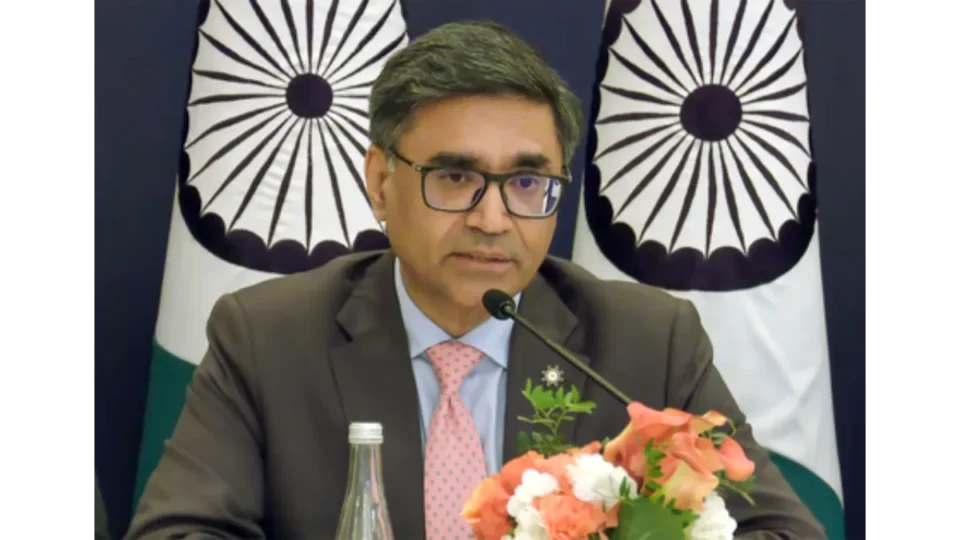
The Government of India has extended the tenure of Foreign Secretary Vikram Misri by one year, until July 14, 2027. The decision, approved by the Appointments Committee of the Cabinet (ACC), ensures continuity in India’s foreign policy leadership amid evolving geopolitical challenges, including developments in the Indo-Pacific, West Asia, Ukraine, and India’s expanding global diplomatic engagement.
Key Highlights
- Government extends Foreign Secretary Vikram Misri’s tenure by one year until July 14, 2027.
- The extension has been approved by the Appointments Committee of the Cabinet (ACC).
- The move ensures continuity in India’s foreign policy during a period of global geopolitical uncertainty.
- Misri has played a key role in strengthening India’s strategic partnerships and crisis diplomacy since 2024.
New Delhi, July 02: The Government of India has approved a one-year extension in the tenure of Foreign Secretary Vikram Misri, allowing the senior diplomat to continue in office until July 14, 2027, beyond his original tenure scheduled to conclude on July 14, 2026.
According to an order issued by the Department of Personnel and Training (DoPT) under the Ministry of Personnel, Public Grievances and Pensions, the Appointments Committee of the Cabinet (ACC) has approved the extension under the provisions of Fundamental Rule 56(d). The extension will remain effective until July 14, 2027, or until further orders, whichever is earlier.
A 1989-batch Indian Foreign Service (IFS) officer, Vikram Misri has served as Foreign Secretary since 2024, leading India’s diplomatic engagement during a period marked by significant geopolitical developments and evolving global challenges.
His tenure has coincided with major international developments, including the conflicts in West Asia and Ukraine, changing strategic dynamics in the Indo-Pacific, India’s growing leadership among the Global South, and complex diplomatic engagements with neighbouring countries, including China, Pakistan, and Bangladesh.
Government sources indicate that the extension reflects confidence in Misri’s leadership, while ensuring policy continuity as India navigates an increasingly complex international environment.
During his distinguished diplomatic career, Vikram Misri has served in key assignments in Pakistan, Europe, and the United States, besides serving as India’s Ambassador to Myanmar and China. His extensive diplomatic experience has contributed significantly to strengthening India’s bilateral and multilateral relationships.
As Foreign Secretary, he has played an important role in advancing India’s strategic partnerships with the United States, the Quad, and European partners while promoting economic diplomacy, strengthening defence and technology cooperation, and addressing issues concerning the Indian diaspora.
He has also been instrumental in coordinating India’s diplomatic response during international crises, including the evacuation of Indian citizens from conflict-affected regions and managing sensitive geopolitical developments.
The extension comes at a crucial time as India prepares for several high-level diplomatic engagements, including activities related to its current BRICS Chairmanship, important bilateral summits, and follow-up engagements arising from recent G20 Summit initiatives.
The decision also reflects the government’s continued preference for experienced leadership in strategic positions requiring institutional knowledge, diplomatic continuity, and long-term policy execution. Continuity at the highest level of the foreign service is expected to support India’s expanding global engagement and reinforce consistency in foreign policy implementation.
Conclusion
The extension of Foreign Secretary Vikram Misri’s tenure until July 2027 underscores the government’s emphasis on stability and continuity in foreign policy leadership. As India strengthens its global diplomatic profile and navigates complex geopolitical developments, experienced leadership at the Ministry of External Affairs is expected to play a vital role in advancing the country’s strategic, economic, and security interests.
