

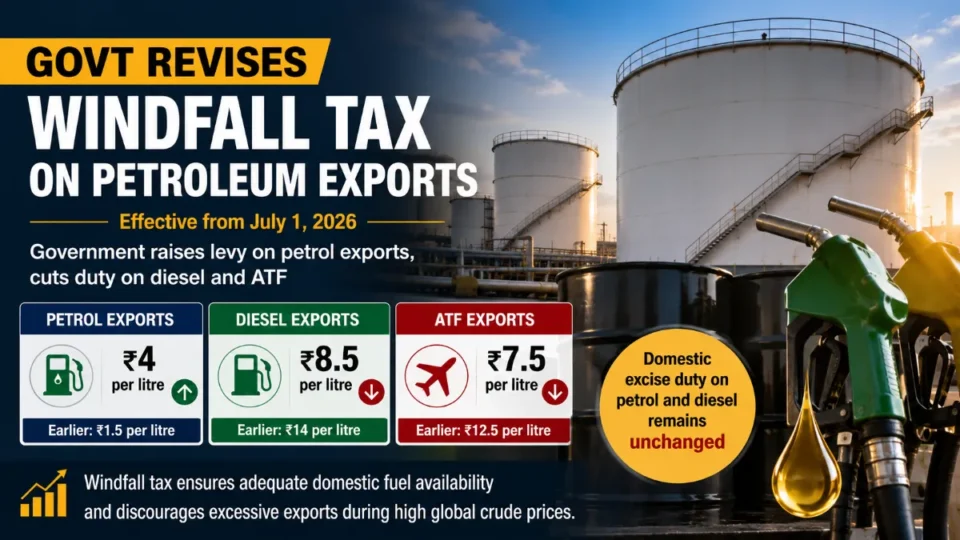
The Central Government has increased the windfall tax on petrol exports from ₹1.5 per litre to ₹4 per litre while reducing the Special Additional Excise Duty (SAED) on diesel exports to ₹8.5 per litre and aviation turbine fuel (ATF) exports to ₹7.5 per litre. The revised rates came into effect on July 1, while excise duties on petrol and diesel sold in the domestic market remain unchanged
Key Highlights
- Petrol export duty increased to ₹4 per litre from ₹1.5 per litre.
- Diesel export levy reduced to ₹8.5 per litre from ₹14 per litre.
- ATF export duty cut to ₹7.5 per litre from ₹12.5 per litre.
- Domestic excise duty on petrol and diesel remains unchanged.
The Ministry of Petroleum and Natural Gas has revised the windfall tax on petroleum product exports, increasing the levy on petrol while reducing duties on diesel and aviation turbine fuel (ATF). The revised Special Additional Excise Duty (SAED) came into force on July 1, according to a notification issued by the Ministry of Finance.
Under the latest revision, the export duty on petrol has been increased to ₹4 per litre from ₹1.5 per litre, reflecting the government’s continued efforts to balance domestic fuel availability and export demand.
At the same time, the government has reduced the export levy on diesel to ₹8.5 per litre from ₹14 per litre, providing some relief to exporters. The SAED on aviation turbine fuel (ATF) has also been cut to ₹7.5 per litre from ₹12.5 per litre.
The Finance Ministry clarified that there is no change in the existing excise duty on petrol and diesel meant for domestic consumption, ensuring that retail consumers will not be directly affected by the latest revision.
The government had initially imposed the export duty on diesel and ATF in March after geopolitical tensions in West Asia pushed global crude oil prices higher. The export levy on petrol was introduced on May 16, with duty rates being reviewed every fortnight based on international market conditions.
In the previous review, the government had raised the windfall tax on diesel and ATF exports while keeping the petrol levy unchanged. The latest revision partially reverses those increases by lowering duties on diesel and ATF while raising the tax on petrol exports.
Separately, state-owned oil marketing companies (OMCs) have reduced the price of 19-kg commercial LPG cylinders by up to ₹183.50, offering relief to restaurants, hotels and other commercial establishments from July 1.
The windfall tax mechanism was introduced to ensure adequate domestic availability of petroleum products and discourage excessive exports during periods of elevated global crude oil prices, particularly when geopolitical developments affect international energy markets.
Conclusion
The latest revision in windfall taxes reflects the government’s strategy of balancing domestic fuel security with export opportunities amid volatile global crude oil prices. While petrol exporters will pay a higher levy, reduced duties on diesel and ATF may provide relief to exporters, with domestic consumers remaining unaffected as retail fuel excise duties have not been changed.
