

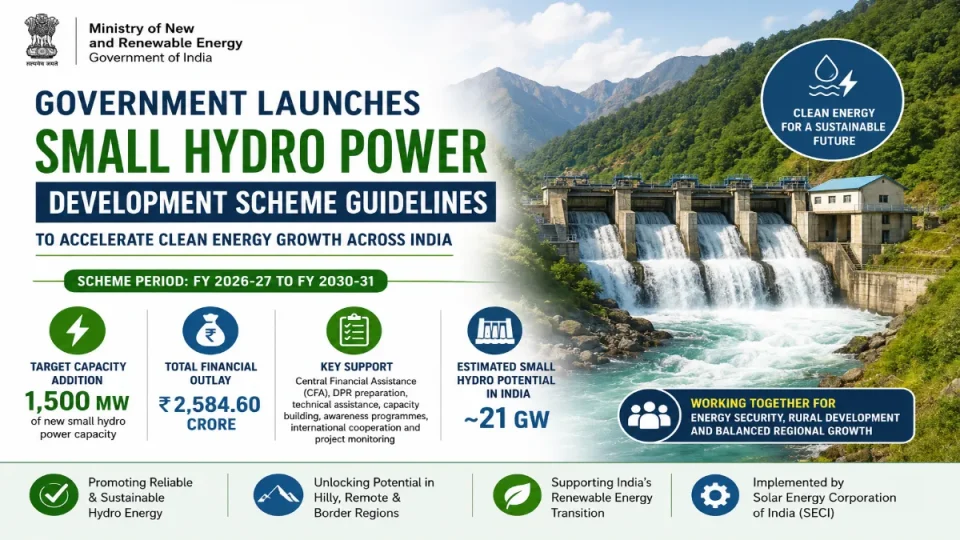
The Ministry of New and Renewable Energy (MNRE) has launched guidelines for the Small Hydro Power Development Scheme for FY 2026-27 to FY 2030-31. The scheme aims to install around 1,500 MW of new small hydro power capacity with a total investment support of ₹2,584.60 crore, helping accelerate India’s renewable energy transition and strengthen energy security.
Key Highlights
- Scheme Period: FY 2026-27 to FY 2030-31
- Total Financial Outlay: ₹2,584.60 crore
- Target Capacity Addition: 1,500 MW
- Implementing Agency: Solar Energy Corporation of India (SECI)
- Support Includes: Central Financial Assistance (CFA), DPR preparation, technical assistance, capacity building, awareness programmes, and project monitoring
- Estimated SHP Potential in India: Around 21 GW
The Government of India on Tuesday launched the guidelines for the Small Hydro Power (SHP) Development Scheme for the period FY 2026-27 to FY 2030-31, marking a major step towards expanding the country’s renewable energy portfolio and harnessing untapped hydropower resources.
The guidelines were unveiled during a national workshop organized by the Ministry of New and Renewable Energy (MNRE), which brought together representatives from state governments, public sector undertakings, project developers, technical institutions, and industry stakeholders associated with the small hydro power sector.
Under the newly launched scheme, the government aims to support the installation of approximately 1,500 MW of new small hydro power capacity across the country. The scheme has been allocated a total financial outlay of ₹2,584.60 crore.
The programme offers Central Financial Assistance (CFA) for project development and implementation. It also includes support for the preparation of Detailed Project Reports (DPRs), assistance to technical institutions, capacity-building initiatives, awareness programmes, international cooperation activities, and project monitoring mechanisms.
Addressing the workshop, Santosh Kumar Sarangi, Secretary, MNRE, emphasized that India’s clean energy transition requires a diversified renewable energy mix and region-specific solutions. He described small hydro power as a mature, reliable, and environmentally sustainable technology capable of enhancing energy security, promoting rural development, and ensuring balanced regional growth.
Sarangi noted that India possesses an estimated 21 GW of small hydro power potential, a significant portion of which remains untapped. He urged states and stakeholders to identify viable project locations, expedite statutory approvals, and create a supportive ecosystem for faster project implementation.
Speaking on the occasion, Rajesh Kulhari, Joint Secretary, MNRE, highlighted the scheme’s potential to unlock hydro resources in hilly, remote, and border regions. He stated that small hydro projects can improve energy access, strengthen local economies, and contribute to grid stability.
Meanwhile, Akash Tripathi, Managing Director of Solar Energy Corporation of India Limited (SECI), reiterated the importance of small hydro power in India’s renewable energy transition. He emphasized the need for close coordination among state governments, developers, and implementing agencies to ensure effective execution of the scheme.
As the designated National Programme Implementing Agency, SECI has committed to facilitating efficient implementation of the initiative and supporting the country’s long-term clean energy objectives.
The launch of the Small Hydro Power Development Scheme is expected to accelerate renewable energy deployment in remote and underserved regions while contributing to India’s clean energy goals. With substantial financial support and a clear implementation framework, the scheme aims to unlock the country’s vast small hydro power potential and strengthen sustainable energy infrastructure.
FAQ
Q1. What is the target capacity under the new Small Hydro Power Development Scheme?
The scheme aims to support the installation of approximately 1,500 MW of new small hydro power capacity.
Q2. What is the total budget allocated for the scheme?
The government has allocated ₹2,584.60 crore for the scheme during FY 2026-31.
Q3. Which ministry launched the scheme?
The scheme was launched by the Ministry of New and Renewable Energy (MNRE).
Q4. What support will be provided under the scheme?
Support includes Central Financial Assistance (CFA), DPR preparation, technical assistance, capacity building, awareness programmes, international cooperation, and project monitoring.
