

One of Worlds biggest elections exercises for a New government begins in India on April 19 and ends on June 01 this year with results being declared on June 04 and June 06 – Model Code of Conduct kicks in
By TN Ashok
New Delhi, March 17: One of the worlds biggest elections exercises gets underway on April 09 in seven phases over a 40 day cycle ending June 01 this year with the results being declared for a new government to be sworn by by June 20, 2024.
Elections in India is an very elaborate exercise because of its geographical spreads and the limited availability of para military forces to maintain law and order and this will be the 18th Lok Sabha elections which throws up 97.8 crore registered voters. That does not mean all 97.8 crore vote. Nut the general pattern is that about 60% of the electorate solicits its franchise in any lok sabha elections.
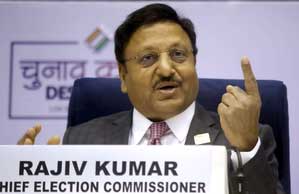
The Chief Election Commissioner Rajiv Kumar , a constitutional authority who is answerable only to the President of India, announced his election machinery will put into action what he called the 4M principle and would be absolutely ruthless in tackling any complaints of misuse of power in terms of muscle power, money power and misinformation purveyed through Fake News. We will come down heavily on any one political party or individual or a social media platform which spreads false information that could cause chaos or violence in polling booths.
The election schedules and timelines as announced by the Election at a crowded press conference of media personnel and TV networks numbering over 1,000 at the spacious Vigyan Bhavan is detailed as follows :
1st Phase – 21 states go to elections – April 19th 2024.
2nd Phase – 13 states to to electiopmsd – April 26th
3rd phase – 12 states go to polls – May 07th
4th phase – 10 states go to polls – May 13th
5th phase – 08 states go to polls – May 20th
6th phase – 07 states g0 to polls – May 25th
7th phase – 08 states go to polls – Jun 01.
Counting will be on June 04 and June 06 and results declared on June 06.
New Government has to be sworn by by June 20th this year.
Simultaneously along with the Lok Sabha elections four states would hold their assembly elections – Odisha, Adhra Pradesh, Manipur and Sikkim.
543 Lok Sabha seats are up for grabs. Any party to form the government must win half the number plus one that is 271+1 = 272 seats to form the government. The ruling party led by the BJP led NDA has declared that it will win 400 seats ( BJP 370+Allies 30) to form the government. While poll surveys including the noted C Voter and ABP poll surveys predict that the ruling BJP would secure 350 seats. The ruling party is weak in the south where 131 seats are up for grabs where BJP now holds 29 seats. The BJP now has 302 seats in the Lok Sabha and 30 seats from the allies to form 352 seats. It hopes to add 18 seats more from West Bengal, Haryana, Rajasthan and Andhra Pradesh. Tamil Nadu could bring a lone Kanyakumari seat the citadel of the BJPs backbone Rashtriya Swayam Sevek Sangh (RSS). DMK along with Congress hopes to sweep 39 seats under the INDIA alliance.
C Voter survey has predicted that the opposition alliance INDIA could get 97 seats along with 98 others to form the opposition bloc. Individual party tallies are not clearly known.
CEC Rajiv Kumar told newsmen that the commission would deal ruthlessly with any party or canddates found using muscle power, money power or spreading false information through FAKE news through social media to cause confusion among votrs leading to eventual violence at polling booths.
The Election Commission is adopting a dual approach to combat misinformation and false narratives on social media during the Lok Sabha polls. Chief Election Commissioner Rajiv Kumar said that the commission will actively counter false information and provide accurate information to voters. “Misinformation is a significant concern for us during elections. While social media aids our outreach efforts and allows for democratic criticism, spreading fake news without factual basis is unacceptable as it can disrupt public order,” he said.
Lok Sabha Election 2024 Live: As the Election Commission announced Lok Sabha election schedule on Saturday, Prime Minister Narendra Modi took on the Opposition, terming them “rudderless,” expressing confidence in retaining power. Meanwhile, the Congress said that this was “perhaps the last chance to save democracy and our Constitution from dictatorship.”
The Election Commission of India (ECI) announced on Saturday that polls for Sikkim’s 32 Assembly seats and one Lok Sabha segment will be held simultaneously on April 19, marking the first phase of the seven-phase general elections. Sikkim’s ruling party, the Sikkim Krantikari Morcha (SKM), which currently holds sway over 19 assembly segments and the Lok Sabha seat, is making vigorous efforts to retain power.
Meanwhile, the Bharatiya Janata Party (BJP) has 12 legislators, while the Sikkim Democratic Front (SDF), which governed for 25 years until its defeat in 2019, has only one MLA. Political observers anticipate a triangular contest in Sikkim between the SKM, SDF, and the newly formed Citizen Action Party (CAP).
Chief election commissioner Rajiv Kumar announced on Saturday that, for the first time in Lok Sabha elections, voters aged above 85 years and those with more than 40 per cent disability will have the option to cast their votes from home.
As of tomorrow the model code of conduct aka MCC kicks in and the ruling party BJP led NDA under Prime Minister Narendra Modi becomes a caretaken government which cannot announce any major schemes but carryout the daily functions and duties wrested with the government.
The Model Code of Conduct (MCC) serves as a collective agreement among all stakeholders and is enforced during elections. Its primary aim is to maintain orderliness, cleanliness, and peace during campaigning, polling, and the counting process. It also serves to prevent the abuse of state machinery and finances by the party in power. CEC Rajiv Kumar said no abusive language should be used by any candidate or political party against their opponents and there should be intereference in the private lives of individuals contesting the elections. Any complain in this regard will be dealth with ruthlesslyt, Rajiv Kumar said adding no religious influence should be exercised by any political party to hurt the sentiments of any faith during the election campaigns.
“I urge parties to refrain from personal attacks and the use of foul language. Certain boundaries in speech have been delineated to uphold civility. Let us not exceed these boundaries in our political rivalries. An advisory has been issued to political parties, encouraging them to promote a political discourse that inspires unity rather than division,” said CEC Rajiv Kumar.
Lok Sabha Election 2024 Live: Nagaland will hold elections for its lone Lok Sabha seat on April 19, announced Election Commission on Saturday. The deadline for filing nominations is March 27, with withdrawal of candidatures allowed until March 30. Scrutiny of nominations will take place on March 28, and counting of votes is scheduled for June 4.
To a question on electoral bonds and the obligation of the SBI to disclose the names of the donors and the beneficiary parties, CEC Rajiv Kumar said this was a critical factor that could influence voters and the commission would spare no effort to put the entire list on its website. At present the SBI and Supreme Court are locking horns on the issue with the former saying it would be difficult to decipher the alphanumeric numbers atop the electoral bonds and match it with the beneficiary parties as there were hundreds of donors and bonds and it would take till June. But the election process would be over by June 01 and the SC apex court said SBI should hasten the process and publish the codes.
The CEC said thousands of officials would be deployed to conduct the elections besides thousands of parala military personnel drawn from the BSF , CISF and local policies would be deployed to maintain law and order. People aged above 50 would have a special queue to cast their franchise and people 85 years and those with 40% disability could stay home and poll officials would come to their homes and collect their votes.
Over 2 crore youths between 18 to 20 will be voting for the first time. 48,000 transgenders would be voting in this election . Besides more women would be casting their votes than men in this election as per the census.
What changes Model Code of Conduct bring this time in the 18th Lo Sabha election. ?
Following the enforcement of the Model Code of Conduct (MCC), several restrictions and guidelines come into effect. Here are the top 10 changes:
1. Restrictions on government announcements: Ministers and authorities are barred from announcing financial grants or making promises once elections are announced. This includes laying foundation stones and initiating projects or schemes, except for civil servants.
2. Discretionary funds and official visits: Ministers cannot sanction grants or payments from discretionary funds after the Lok Sabha election schedule is announced.
3. Use of government resources: Official visits cannot be combined with electioneering, and the use of official machinery or personnel for election purposes is prohibited. This includes government transport and public places for election meetings.
4. Accommodation and campaigning: Government accommodations should not be monopolised by the ruling party or its candidates. Using them for campaign purposes is also prohibited.
5. Avoidance of partisan coverage: Advertisements at the cost of public exchequer in media are prohibited during the election period. Misuse of official mass media for partisan coverage of political news is strictly avoided.
The Model Code of Conduct (MCC) has been activated following the Election Commission of India’s announcement of the election dates for the Lok Sabha and four state assemblies. Chief election commissioner Rajiv Kumar has urged all political parties and their leaders to adhere strictly to the poll code.
Congress leader Priyank Kharge criticised the Election Commission’s decision of holding polls in seven phases saying that the announcement of the election dates seems to “favour Prime Minister Modi and the BJP”.
