

Visit Aims at Strengthening India’s Presence in the African Continent
By TN Ashok Diplomatic Editor
 New Delhi, March 20 India’s External Affairs Minister Ms Sushma Swaraj will pay a four day visit to the African continent visiting Tanzania and South Africa on March 28/29 (Tanzania) and March 29 to 31 (South Africa) as part of Modi government’s aggressive foreign policy initiatives to strengthen political and economic ties with countries with which India has had a long history of cordial relations.
Ms Swaraj will be the first external affairs minister from India to visit Tanzania since 2013. Our former Prime Minister Dr Manmohan Singh had visited Tanzania as the head of the UPA government in 2011.
 India and Tanzania have a trade volume of US $ 4 billion weighing in favour of India with balance of trade tilted at US $ 2.5 billion and US $ 1.5 billion in favour of Tanzania. Over 50,000 people of Indian origin live and work in Tanzania. India constitutes a major part of the expatriate population of Tanzania.
Ms Swaraj;s visit to South Africa is aimed at expanding India’s economic ties with that country. India and South Africa enjoy a bilateral trade of US 11 billion weighted in favour of South Africa at US $ 6 billion and balance of trade with India being US $ 5 billion. India is seeking to increase its exports so that the balance of trade is reversed in favour of India.
South Africa is India’s largest trading partner in the African continent next only to Nigeria with which India has a fairly large trading volume.
India proposes to discuss global governance issues besides climate change matters with South Africa which is part of the IBSA group (India Brazil and South Africa) as compared to the BRICS where they share more general and varied international issues.
Brief Backgrounder on Tanzania and South Africa:
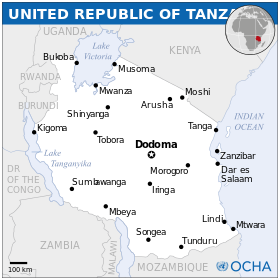
Tanzania: United Republic of Tanzania is a country in East Africa within the African Great Lakes region. It is bordered by Kenya and Uganda to the north; Rwanda, Burundi, and the Democratic Republic of the Congo to the west; Zambia, Malawi, and Mozambique to the south; and the Indian Ocean to the east. Kilimanjaro, Africa’s highest mountain, is in north eastern Tanzania.
Tanzania’s population of 44.9 million is highly diverse, composed of numerous ethnic, linguistic, and religious groups. Tanzania is a presidential constitutional republic, and since 1996, its official capital has been Dodoma, where the President’s Office, the National Assembly, and some government ministries are located.Dar es Salaam, the former capital, retains most government offices and is the country’s largest city, principal port, and leading commercial center.
European colonialism began in mainland Tanzania during the late 19th century when Germany formed German East Africa, which gave way to British rule following World War I.
The mainland was governed as Tanganyika, with the Zanzibar Archipelagoremaining a separate colonial jurisdiction. Following their respective independence in 1961 and 1963, the two entities merged in April 1964 to form the United Republic of Tanzania.
Tanzania is a one party dominant state with the Chama Cha Mapinduzi (CCM) party in power. From its formation until 1992, it was the only legally permitted party in the country. This changed on 1 July 1992, when amendments to the Constitution and a number of laws permitting and regulating the formation and operations of more than one political party were enacted by the National Assembly. Elections for president and all National Assembly seats were last held in October 2010.] The CCM holds approximately 75% of the seats in the assembly.
Legislature
The parliament of Tanzania consists of two parts: the president and the National Assembly.
The president and the members of the National Assembly are elected concurrently by direct popular vote for five-year terms. The vice-president is elected for a five-year term at the same time as the president and on the same ticket.
Neither the president nor the vice-president may be a member of the National Assembly. The president appoints a prime minister, subject to confirmation by the assembly, to serve as the government’s leader in the assembly. The president selects his or her cabinet from assembly members.
All legislative power relating to mainland Tanzania and union matters is vested in the National Assembly, which is unicameral and has a maximum of 357 members. These include members elected to represent constituencies, the attorney general, five members elected by the Zanzibar house of representatives from among its own members, the special women’s seats that constitute at least 30% of the seats that any party has in the assembly, the speaker of the assembly (if not otherwise a member of the assembly), and the persons (not more than ten) appointed by the president. The Tanzania Electoral Commission demarcates the mainland into constituencies in the number determined by the commission with the consent of the president.
Multilateral relations
Tanzania is a member of the East African Community (EAC), along with Uganda, Kenya, Rwanda, and Burundi.[70] According to the East African Common Market Protocol of 2010, the free trade and free movement of people is guaranteed, including the right to reside in another member country for purposes of employment. This protocol, however, has not been implemented because of work permit and other bureaucratic, legal, and financial obstacles.
Tanzania is also a member of the Southern African Development Community (SADC). The EAC, the SADC, and the Common Market for Eastern and Southern Africa agreed in June 2011 to negotiate the creation of a Tripartite Free Trade Area spanning 26 African countries, with a goal to complete the first phase of negotiations within 36 months.
As of 31 October 2014, Tanzania was contributing 2,253 soldiers and other personnnel to various United Nations peacekeeping operations. The Tanzanian military is participating along with South African and Malawian militaries in the United Nations Force Intervention Brigade (MONUSCO) in the Democratic Republic of the Congo (DRC). The United Nations Security Council authorized the force on 28 March 2013 to conduct targeted offensive operations to neutralize groups that threaten peace in the DRC. Tanzania was also participating in peacekeeping missions in the Darfur Region of Sudan (UNAMID);
South Africa
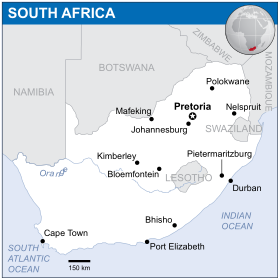
South Africa, the Republic of South Africa (RSA), is located in Southern Africa. It has 2,798 kilometres (1,739 mi) of coastline that stretches along the South Atlantic and Indian oceans. To the north lie the neighbouring countries of Namibia, Botswana and Zimbabwe; to the east are Mozambique and Swaziland; and within it lies Lesotho, an enclavesurrounded by South African territory. South Africa is the 25th-largest country in the world by land area, and with close to 53 million people, is the world’s 25th-most populous nation.
South Africa is a multi-ethnic society encompassing a wide variety of cultures, languages, and religions. Its pluralistic makeup is reflected in the constitution’s recognition of 11 official languages, which is among the highest number of any country in the world. Two of these languages are of European origin: Afrikaans developed from Dutch and serves as the first language of most white and coloured South Africans, based on history; English reflects the legacy of British colonialism, and is commonly used in public and commercial life, though it is fourth-ranked as a spoken first language.
About 80 percent of South Africans are of black sub-Saharan African ancestry, divided among a variety of ethnic groups speaking different Bantu languages, nine of which have official status. The remaining population consists of Africa’s largest communities of European (white), Asian (Indian), and multiracial (coloured) ancestry. Since 1994, all ethnic and linguistic groups have had political representation in the country’s constitutional democracy, which comprises a parliamentary republic and nine provinces. South Africa is often referred to as the “Rainbow Nation,” a term coined by Archbishop Desmond Tutu and later adopted by then-President Nelson Mandela as a metaphor to describe the country’s newly developing multicultural diversity in the wake of segregationist apartheid ideology.
The country is one of the few in Africa never to have had a coup d’état, and regular elections have been held for almost a century. But the vast majority of black South Africans were not enfranchised until 1994. During the 20th century, the black majority sought to recover its rights from the dominant white minority, with this struggle playing a large role in the country’s recent history and politics. The National Party imposed apartheid in 1948, institutionalizing previous racial segregation. After a long and sometimes violent struggle by the African National Congress and other anti-apartheid activists, discriminatory laws began to be repealed or abolished from 1990 onwards.
South Africa is ranked as an upper-middle income economy by the World Bank, and is considered to be a newly industrialised country. Its economy is the second-largest in Africa, and the 34th-largest in the world. In terms of purchasing power parity, South Africa has the seventh-highest per capita income in Africa. But poverty and inequality remain widespread, with about a quarter of the population unemployed and living on less than US$1.25 a day. Nevertheless, South Africa has been identified as a middle power in international affairs, and maintains significant regional influence
South Africa is a parliamentary republic, although unlike most such republics the President is both head of state and head of government, and depends for his tenure on the confidence of Parliament. The executive, legislature and judiciary are all subject to the supremacy of the Constitution, and the superior courts have the power to strike down executive actions and acts of Parliament if they are unconstitutional.
The National Assembly, the lower house of Parliament, consists of 400 members and is elected every five years by a system of party-list proportional representation. The National Council of Provinces, the upper house, consists of ninety members, with each of the nine provincial legislatures electing ten members.
After each parliamentary election, the National Assembly elects one of its members as President; hence the President serves a term of office the same as that of the Assembly, normally five years. No President may serve more than two terms in office. The President appoints a Deputy President and Ministers, who form the Cabinet which consists of Departments and Ministries. The President and the Cabinet may be removed by the National Assembly by a motion of no confidence.
Jacob Zuma, President of South Africa since 2009
In the most recent election, held on 7 May 2014, the African National Congress (ANC) won 62.2% of the vote and 249 seats, while the main opposition, the Democratic Alliance (DA) won 22.2% of the vote and 89 seats. The Economic Freedom Fighters, founded by Julius Malema, the former President of the ANC’s Youth Wing who was later expelled from the ANC, won 6.4% of the vote and 25 seats. The ANC has been the governing political party in South Africa since the end of apartheid.
South Africa has no legally defined capital city. The fourth chapter of the Constitution of South Africa, states that “The seat of Parliament is Cape Town, but an Act of Parliament enacted in accordance with section 76(1) and (5) may determine that the seat of Parliament is elsewhere. The country’s three branches of government are split over different cities. Cape Town, as the seat of Parliament, is the legislative capital; Pretoria, as the seat of the President and Cabinet, is the administrative capital; and Bloemfontein, as the seat of the Supreme Court of Appeal, is the judicial capital, while the Constitutional Court of South Africa sits in Johannesburg.
