

By TN Ashok Economics Editor
New Delhi, Feb 28: The 2014-`15 Economic Survey presented to Parliament by the Modi led BJP led NDA government has outlined a reforms package for psu banks which includes exiting the non performing banks with high non-performing assets in its kitty. This is based on government’s new policy to capitalise banks on the basis of their efficiency.
Currently, all state-owned psu banks are treated alike irrespective of their size , in all areas ranging from the appointment process, compensation policies, distribution of capital, or employee performance.
The Economic Survey noted that any differentiation will provide options such as selective recapitalisation, diluted government ownership, and exit. However, the survey does not detail the exit options. It may be recalled that the RBI appointed PJ Nayak committee went into governance issues in public sector banks and was of the opinion that government break free of its control over public sector banks reducing its stake below 51 per cent.
The current position is that government wants to reduce its stake up to 52 per cent. Governments’ shareholding in some banks is as high as 81%. .
The survey has suggested reforms in four areas, 4 Ds — deregulate, differentiate, diversify, and disinter. The 4 Ds of banking sector reforms are:
* Deregulate: SLR needs to be brought down, priority sector lending norms should be revisited
* Differentiate: Wide variation among public sector banks’ performance; public ownership, exit and recapitalisation should be on selective basis
* Diversify: Need to have new banks, new type of banks
* Disinter: Better bankruptcy procedures is essential; need for Independent Renegotiation Commission with political authority and reputational integrity to resolve big and difficult cases
According to some reports in the media, in order to address the asset side repression of the banking system, deregulation has been suggested in terms of lowering the minimum requirement for statutory liquidity ratio. SLR is the proportion of net demand and time liabilities that a bank needs to invest in government papers.
The observation is in conformity with the banking regulator’s suggestion that it will release funds for banks which could be deployed in the productive sector. But the government needs to observe financial discipline because SLR is often used as a means to bulk of the fiscal deficit.
The survey noted against the minimum SLR a bank can hold at stipulated 21.5 per cent, it held more than 25 per cent.
The survey identified another area of deregulation as revisiting the priority sector norms that needed to be redefined making it more priority sector targeted, smaller, and need-driven, the Survey said.
On the need for a diversified banking sector, the survey said India needed different kind of banks. It is learnt the banking regulator has already taken steps in the direction by agreeing to offer niche bank licences.
The fourth D, which is disinter, according to media reports , refers to robust recovery mechanism and a bankruptcy law. RBI has also emphasised the need of a bankruptcy code in India in order to tackle the problem of wilful defaulters. Delay in loan recovery is one of the reasons behind the pile-up of stressed assets in the banking system. Currently, such assets constitute over 10 per cent of the total loans given by banks, impacting their profitability. “Distressed assets hang like a Damocles sword over the economy and require creative solution.”
“When the next boom and bust comes around, India needs to be better prepared to distribute pain between promoters, creditors, consumers, and taxpayers. Being prepared for the clean-up is as important as the being prudent in the run-up,” the survey said.
Private Sector Banks criticised for slow growth
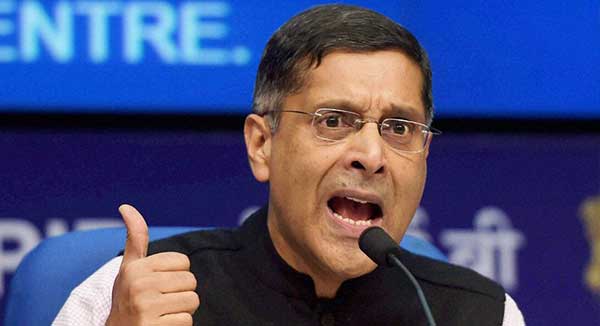
Private sector banks did not escape the ire of the Economic Survey, prepared by the US based Dr Arvind Subramanian, recently appointed as the Chief Economic Advisor to the Finance Ministry and the government. The CEA normally prepares the Economic Survey with a team of economic experts drawn from the economic ministries of the government.
The survey pointed out that private sector banks were growing slowly even though private companies in other sectors have contributed significantly to growth. Their share of growth in the share of the private sector in overall banking aggregates “barely increased” at a time when the other sectors in the country witnessed a rapid rise of private sector players.
Concern was also expressed over lack of adequate competition in the banking sector. Competition picked up and private sector banks had seen a steady growth between the years 1990-2007. However, it is in post 2007 that the growth of private sector banks has been in a slow lane.
“India saw a steady rise in the size of private sector banks till 2007 both in relation to deposit and lending indicators. Thereafter, the process slowed considerably (and of course in the aftermath of the Lehman crisis, there was a flight to safety toward the PSBs,” said the survey.
