

India highlighted its major labour reforms and employment achievements at the 114th International Labour Conference in Geneva, with Union Minister Shobha Karandlaje stating that youth employability has risen to over 56%, unemployment has fallen to 3.1%, and women’s workforce participation has increased significantly. The country also showcased its labour codes, social protection initiatives and digital employment platforms.
✅ India showcased labour reforms at the 114th International Labour Conference (ILC) in Geneva.
✅ 29 Central Labour Laws consolidated into four Labour Codes.
✅ Youth employability increased from 34% in 2014 to over 56% in 2025.
✅ Unemployment rate declined from 6% in 2017 to 3.1% in 2025.
✅ Women’s workforce participation rose from 22% to 38.8%.
✅ Social protection coverage expanded to 68.4% of the population.
✅ India promoted e-Shram and National Career Service Portal as digital public goods.
New Delhi, June 11: India highlighted its transformative labour reforms, employment growth and social protection initiatives at the 114th International Labour Conference (ILC) in Geneva, Switzerland, with Union Minister of State for Labour and Employment Shobha Karandlaje leading the Indian delegation.
Addressing the plenary session of the conference, Karandlaje congratulated the International Labour Organization (ILO) for organizing the event and acknowledged its role in promoting social justice, inclusive growth and decent work opportunities amid changing global economic and technological landscapes.
The minister emphasized that India’s labour reform agenda has been guided by the principle of “Antyodaya”, focusing on the welfare of the most vulnerable sections of society while creating a modern, transparent and efficient labour ecosystem.
A major pillar of these reforms has been the consolidation of 29 Central Labour Laws into four Labour Codes aimed at simplifying compliance procedures, improving ease of doing business and strengthening worker welfare.
Highlighting India’s employment progress, Karandlaje informed delegates that youth employability has increased substantially over the last decade.
According to the minister, youth employability in India rose from 34 per cent in 2014 to more than 56 per cent in 2025, reflecting improvements in skilling, education and employment opportunities.
She also noted significant gains in labour market indicators during the period between 2017 and 2025.
India’s unemployment rate declined from 6 per cent to 3.1 per cent, while women’s workforce participation increased from 22 per cent to 38.8 per cent, demonstrating broader inclusion and economic participation.
The minister also highlighted the government’s efforts to generate employment through initiatives such as the Pradhan Mantri Viksit Bharat Rozgar Yojana, which seeks to create new job opportunities and strengthen workforce development.
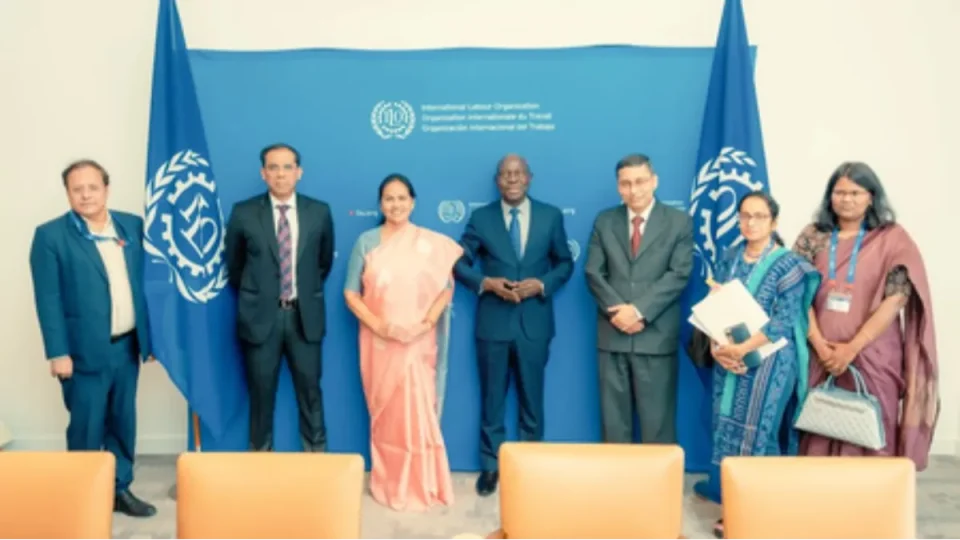
On the sidelines of the conference, Karandlaje held a bilateral meeting with Gilbert F. Houngbo, Director-General of the International Labour Organization.
During the meeting, she reaffirmed India’s commitment to working closely with the ILO in advancing decent work, social justice and inclusive economic development.
The minister informed the ILO leadership that India’s social protection coverage has expanded significantly and now covers 68.4 per cent of the country’s population, benefiting approximately 1.001 billion people, according to preliminary ILO estimates.
India also showcased its digital governance initiatives, including the National Career Service (NCS) Portal and the e-Shram Portal, which have emerged as important digital platforms for employment services, worker registration, job matching and skill development.
Karandlaje held separate bilateral meetings with Rwanda’s Minister of Public Service and Labour, Christine Nkulikiyinka, and Sri Lanka’s Labour Minister, Anil Jayantha Fernando.
Discussions with Rwanda focused on cooperation in employment services, workforce planning, skilling initiatives and digital governance. India offered technical support and capacity-building assistance for developing digital employment and worker registration platforms.
Meanwhile, Sri Lanka expressed interest in learning from India’s experience in implementing the four Labour Codes and sought insights into the country’s labour reform process.
The engagements underscored India’s growing role in shaping global discussions on employment, labour reforms, digital governance and social protection systems.
India’s participation in the 114th International Labour Conference highlighted the country’s progress in labour reforms, employment generation and social security expansion. Through the implementation of four Labour Codes, digital employment platforms and workforce development initiatives, India is positioning itself as a key contributor to global efforts aimed at promoting decent work, inclusive growth and social justice.
FAQ Section
Q1. What are India’s four Labour Codes?
The four Labour Codes consolidate 29 Central Labour Laws into a simplified framework covering wages, industrial relations, social security and occupational safety.
Q2. What employment achievements did India highlight at the ILC?
India reported that youth employability increased to over 56%, unemployment fell to 3.1% and women’s workforce participation rose to 38.8%.
Q3. Who represented India at the International Labour Conference?
Union Minister of State for Labour and Employment Shobha Karandlaje led the Indian delegation.
Q4. What is the e-Shram Portal?
The e-Shram Portal is a government platform designed for registration and welfare support of workers, particularly those in the unorganized sector.
Q5. What is India’s current social protection coverage?
According to preliminary ILO estimates, India’s social protection coverage has reached 68.4% of the population, covering approximately 1.001 billion beneficiaries.
